Cambridge 13 Test 1 Listening

CAMBRIDGE 13 TEST 1 LISTENING

SECTION 1 Audio

SECTION 1

Questions 1–10

Complete the table below.

Write ONE WORD AND/OR A NUMBER for each answer.

COOKERY CLASSES

Cookery ClassFocusOther Information
Example
The Food …Studio…
how to 1 and cook with seasonal products ● small classes
● also offers 2 classes
● clients who return get a 3 discount
Bond’s Cookery School food that is 4 ● includes recipes to strengthen your 5
● they have a free 6 every Thursday
The 7 Centre mainly 8 food ● located near the 9
● a special course in skills with a 10 is sometimes available

SECTION 2 Audio

SECTION 2

Questions 11–13

Choose the correct letter, A, B or C.

Traffic Changes in Granford

11 Why are changes needed to traffic systems in Granford?

A The number of traffic accidents has risen.
B The amount of traffic on the roads has increased.
C The types of vehicles on the roads have changed.

12 In a survey, local residents particularly complained about

A dangerous driving by parents.
B pollution from trucks and lorries.
C inconvenience from parked cars.

13 According to the speaker, one problem with the new regulations will be

A raising money to pay for them.
B finding a way to make people follow them.
C getting the support of the police.

Questions 14–20

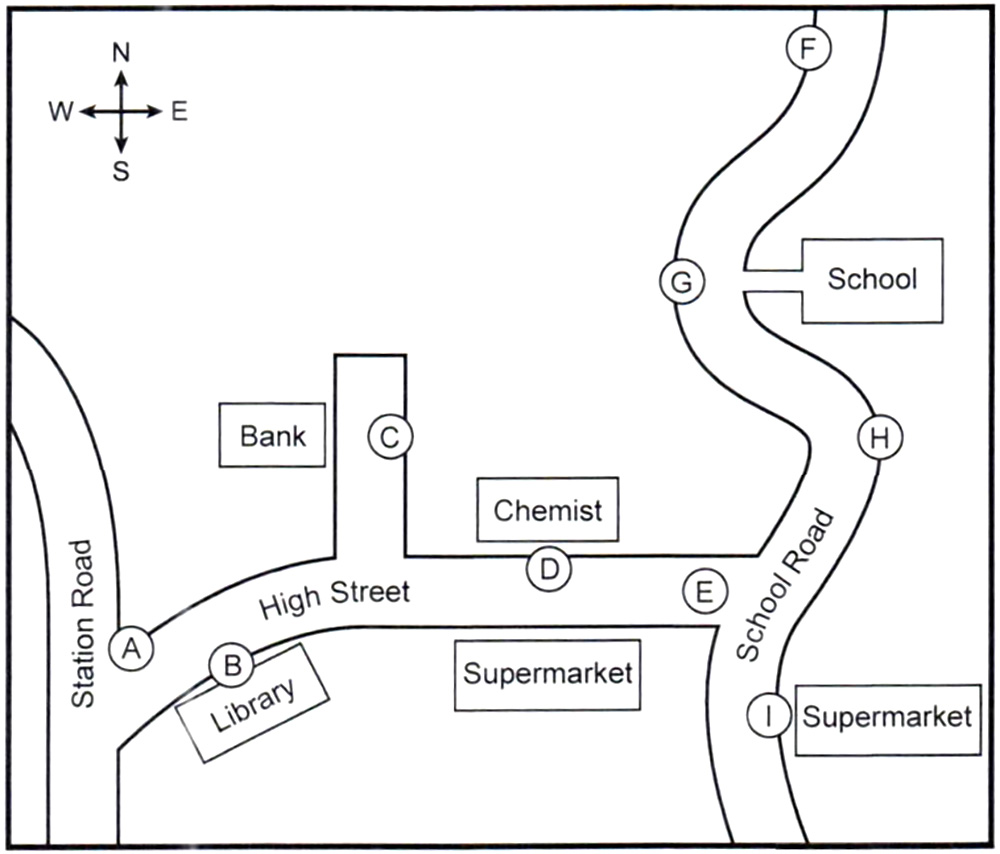
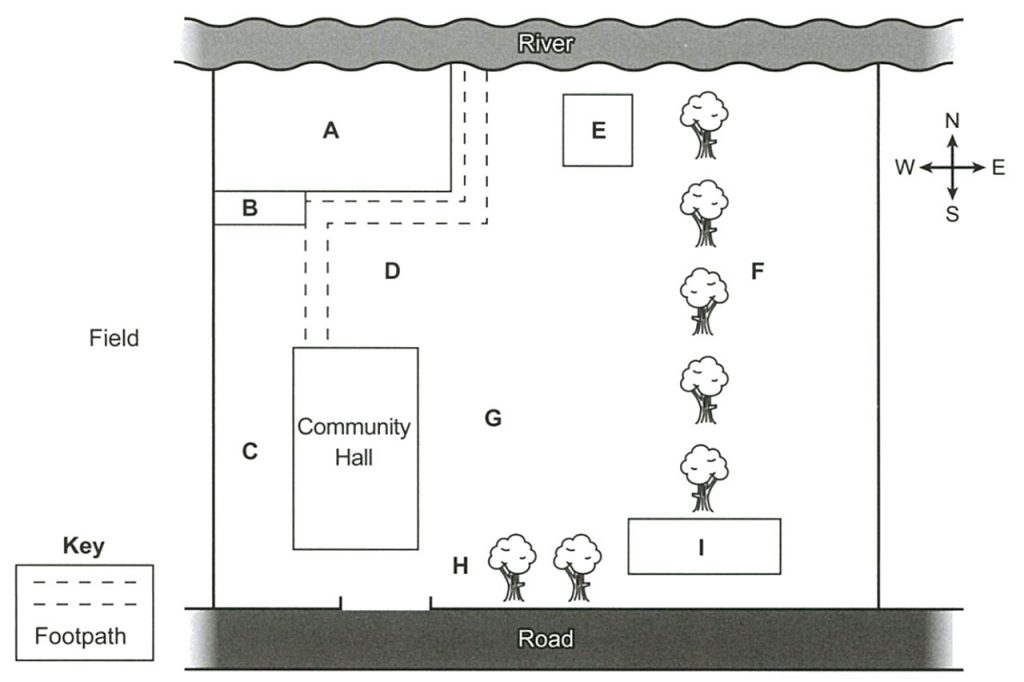
Label the map below.

Write the correct letter, A-I, next to Questions 14-20.

Proposed traffic changes in Granford

Proposed traffic changes in Granford map

14 New traffic lights

15 Pedestrian crossing

16 Parking allowed

17 New ‘No Parking’ sign

18 New disabled parking spaces

19 Widened pavement

20 Lorry loading/unloading restrictions

SECTION 3 Audio

SECTION 3

Questions 21–25

Choose the correct letter, A, B or C.

21 Why is Jack interested in investigating seed germination?

A He may do a module on a related topic later on.
B He wants to have a career in plant science.
C He is thinking of choosing this topic for his dissertation.

22 Jack and Emma agree the main advantage of their present experiment is that it can be

A described very easily.
B carried out inside the laboratory.
C completed in the time available.

23 What do they decide to check with their tutor?

A whether their aim is appropriate
B whether anyone else has chosen this topic
C whether the assignment contributes to their final grade

24 They agree that Graves’ book on seed germination is disappointing because

A it fails to cover recent advances in seed science.
B the content is irrelevant for them.
C its focus is very theoretical.

25 What does Jack say about the article on seed germination by Lee Hall?

A The diagrams of plant development are useful.
B The analysis of seed germination statistics is thorough.
C The findings on seed germination after fires are surprising.

Questions 26–30

Complete the flow-chart below.

Choose FIVE answers from the box and write the correct letter, A-H, next to Questions 26-30.

A container    B soil    C weight    D condition
E height    F colour    G types    H depths

Stage in the experiment

Select seeds of different and sizes.

Measure and record the and size of each one.

Decide on the to be used.

Use a different for each seed and label it.

After about 3 weeks, record the plant’s .

Investigate the findings.

SECTION 4 Audio

SECTION 4

Questions 31–40

Complete the notes below.

Write ONE WORD ONLY for each answer.

Effects of urban environments on animals

Introduction

Recent urban developments represent massive environmental changes. It was previously thought that only a few animals were suitable for city life, e.g.

● the 31 – because of its general adaptability

● the pigeon – because walls of city buildings are similar to 32

In fact, many urban animals are adapting with unusual 33 .

Recent research

● Emilie Snell-Rood studied small urbanised mammal specimens from museums in Minnesota.

– She found the size of their 34 had increased.

– She suggests this may be due to the need to locate new sources of 35 and to deal with new dangers.

● Catarina Miranda focused on the 36 of urban and rural blackbirds.

– She found urban birds were often braver, but were afraid of situations that were 37

● Jonathan Atwell studies how animals respond to urban environments.

– He found that some animals respond to 38 by producing lower levels of hormones.

● Sarah Partan’s team found urban squirrels use their 39 to help them communicate.

Long-term possibilities

Species of animals may develop which are unique to cities. However, some changes may not be 40 .
Cambridge 13 Test 2 Listening

CAMBRIDGE 13 TEST 2 LISTENING

SECTION 1 Audio

SECTION 1

Questions 1–10

Complete the notes below.

Write ONE WORD AND/OR A NUMBER for each answer.

South City Cycling Club

Example
Name of club secretary: Jim …..Hunter…..

Membership

● Full membership costs $260; this covers cycling and 1 all over Australia

● Recreational membership costs $108

● Cost of membership includes the club fee and 2

● The club kit is made by a company called 3

Training rides

● Chance to improve cycling skills and fitness

● Level B: speed about 4 kph

● Weekly sessions
– Tuesdays at 5.30 am, meet at the 5
– Thursdays at 5.30 am, meet at the entrance to the 6

Further information

● Rides are about an hour and a half

● Members often have 7 together afterwards

● There is not always a 8 with the group on these rides

● Check and print the 9 on the website beforehand

● Bikes must have 10

SECTION 2 Audio

SECTION 2

Questions 11–16

Choose the correct letter, A, B or C.

Information on company volunteering projects

11 How much time for volunteering does the company allow per employee?

A two hours per week
B one day per month
C 8 hours per year

12 In feedback almost all employees said that volunteering improved their

A chances of promotion.
B job satisfaction.
C relationships with colleagues.

13 Last year some staff helped unemployed people with their

A literacy skills.
B job applications.
C communication skills.

14 This year the company will start a new volunteering project with a local

A school.
B park.
C charity.

15 Where will the Digital Inclusion Day be held?

A at the company’s training facility
B at a college
C in a community centre

16 What should staff do if they want to take part in the Digital Inclusion Day?

A fill in a form
B attend a training workshop
C get permission from their manager

Questions 17 and 18

Choose TWO letters, A-E.

What TWO things are mentioned about the participants on the last Digital Inclusion Day?

Questions 19 and 20

Choose TWO letters, A-E.

What TWO activities on the last Digital Inclusion Day did participants describe as useful?

SECTION 3 Audio

SECTION 3

Questions 21–25

Choose the correct letter, A, B or C.

Planning a presentation on nanotechnology

21 Russ says that his difficulty in planning the presentation is due to

A his lack of knowledge about the topic.
B his uncertainty about what he should try to achieve.
C the short time that he has for preparation.

22 Russ and his tutor agree that his approach in the presentation will be

A to concentrate on how nanotechnology is used in one field.
B to follow the chronological development of nanotechnology.
C to show the range of applications of nanotechnology.

23 In connection with slides, the tutor advises Russ to

A talk about things that he can find slides to illustrate.
B look for slides to illustrate the points he makes.
C consider omitting slides altogether.

24 They both agree that the best way for Russ to start his presentation is

A to encourage the audience to talk.
B to explain what Russ intends to do.
C to provide an example.

25 What does the tutor advise Russ to do next while preparing his presentation?

A summarise the main point he wants to make
B read the notes he has already made
C list the topics he wants to cover

Questions 26–30

Choose FIVE answers from A-G.

A lacked a conclusion
B useful in the future
C not enough
D sometimes distracting
E showed originality
F covered a wide range
G not too technical

26 structure

27 eye contact

28 body language

29 choice of words

30 handouts

SECTION 4 Audio

SECTION 4

Questions 31–40

Complete the notes below.

Write ONE WORD ONLY for each answer.

Episodic memory

● the ability to recall details, e.g. the time and 31 of past events

● different to semantic memory – the ability to remember general information about the 32 , which does not involve recalling 33 information

Forming episodic memories involves three steps:

Encoding

● involves receiving and processing information

● the more 34 given to an event, the more successfully it can be encoded

● to remember a 35 , it is useful to have a strategy for encoding such information

Consolidation

● how memories are strengthened and stored

● most effective when memories can be added to a 36 of related information

● the 37 of retrieval affects the strength of memories

Retrieval

● memory retrieval often depends on using a prompt, e.g. the 38 of an object near to the place where you left your car

Episodic memory impairments

● these affect people with a wide range of medical conditions

● games which stimulate the 39 have been found to help people with schizophrenia

● children with autism may have difficulty forming episodic memories – possibly because their concept of the 40 may be absent

● memory training may help autistic children develop social skills

Cambridge 13 Test 3 Listening

CAMBRIDGE 13 TEST 3 LISTENING

SECTION 1 Audio

SECTION 1

Questions 1–10

Complete the notes below.

Write ONE WORD AND/OR A NUMBER for each answer.

Moving to Banford City

Example
Linda recommends living in suburb of: …..Dalton…..

Accommodation

● Average rent: £ 1 a month

Transport

● Linda travels to work by 2

● Limited 3 in city centre

● Trains to London every 4 minutes

● Poor train service at 5

Advantages of living in Banford

● New 6 opened recently

● 7 has excellent reputation

● Good 8 on Bridge Street

Meet Linda

● Meet Linda on 9 after 5.30 pm

● In the 10 opposite the station

SECTION 2 Audio

SECTION 2

Questions 11–16

What advantage does the speaker mention for each physical activity?

Choose SIX answers from the box and write the correct letter, A-G.

Advantages
A not dependent on season
B enjoyable
C low risk of injury
D fitness level unimportant
E sociable
F fast results
G motivating

11 using a gym

12 running

13 swimming

14 cycling

15 doing yoga

16 training with a personal trainer

Questions 17 and 18

Choose TWO letters, A-E.

For which TWO reasons does the speaker say people give up going to the gym?

Questions 19 and 20

Choose TWO letters, A-E.

Which TWO pieces of advice does the speaker give for setting goals?

SECTION 3 Audio

SECTION 3

Questions 21–24

Choose the correct letter, A, B or C.

Project on using natural dyes to colour fabrics

21 What first inspired Jim to choose this project?

A textiles displayed in an exhibition
B a book about a botanic garden
C carpets he saw on holiday

22 Jim eventually decided to do a practical investigation which involved

A using a range of dyes with different fibres.
B applying different dyes to one type of fibre.
C testing one dye and a range of fibres.

23 When doing his experiments, Jim was surprised by

A how much natural material was needed to make the dye.
B the fact that dyes were widely available on the internet.
C the time that he had to leave the fabric in the dye.

24 What problem did Jim have with using tartrazine as a fabric dye?

A It caused a slight allergic reaction.
B It was not a permanent dye on cotton.
C It was ineffective when used on nylon.

Questions 25–30

What problem is identified with each natural dye?

Choose SIX answers from the box and write the correct letter, A-H.

Problems
A It is expensive.
B The colour is too strong.
C The colour is not long-lasting.
D It is very poisonous.
E It can damage the fabric.
F The colour may be unexpected.
G It is unsuitable for some fabrics.
H It is not generally available.

25 turmeric

26 beetroot

27 Tyrian purple

28 logwood

29 cochineal

30 metal oxide

SECTION 4 Audio

SECTION 4

Questions 31–40

Complete the notes below.

Write ONE WORD ONLY for each answer.

The sleepy lizard (Tiliqua rugosa)

Description

● They are common in Western and South Australia

● They are brown, but recognisable by their blue 31

● They are relatively large

● Their diet consists mainly of 32

● Their main predators are large birds and 33

Navigation study

● One study found that lizards can use the 34 to help them navigate

Observations in the wild

● Observations show that these lizards keep the same 35 for several years

Possible reasons:

– to improve the survival of their young
(but little 36 has been noted between parents and children)

– to provide 37 for female lizards

Tracking study

– A study was carried out using GPS systems attached to the 38 of the lizards

– This provided information on the lizards’ location and even the number of 39 taken

– It appeared that the lizards were trying to avoid one another

– This may be in order to reduce chances of 40

Cambridge 13 Test 4 Listening

CAMBRIDGE 13 TEST 4 LISTENING

SECTION 1 Audio

SECTION 1

Questions 1–10

Complete the notes below.

Write ONE WORD AND/OR A NUMBER for each answer.

Alex’s Training

Example
Alex completed his training in …..2014……

About the applicant:

● At first, Alex did his training in the 1 department.

● Alex didn’t have a qualification from school in 2 .

● Alex thinks he should have done the diploma in 3 skills.

● Age of other trainees: the youngest was 4 .

Benefits of doing training at JPNW:

● Lots of opportunities because of the size of the organisation.

● Trainees receive the same amount of 5 as permanent staff.

● The training experience increases people’s confidence a lot.

● Trainees go to 6 one day per month.

● The company is in a convenient 7 .

Advice for interview:

● Don’t wear 8 .

● Don’t be 9 .

● Make sure you 10 .

SECTION 2 Audio

SECTION 2

Questions 11–16

Choose the correct letter, A, B or C.

The Snow Centre

11 Annie recommends that when cross-country skiing, visitors should

A get away from the regular trails.
B stop to enjoy views of the scenery.
C go at a slow speed at the beginning.

12 What does Annie tell the group about this afternoon’s dog-sled trip?

A Those who want to can take part in a race.
B Anyone has the chance to drive a team of dogs.
C One group member will be chosen to lead the trail.

13 What does Annie say about the team relay event?

A All participants receive a medal.
B The course is 4 km long.
C Each team is led by a teacher.

14 On the snow-shoe trip, the visitors will

A visit an old gold mine.
B learn about unusual flowers.
C climb to the top of a mountain.

15 The cost of accommodation in the mountain hut includes

A a supply of drinking water.
B transport of visitors’ luggage.
C cooked meals.

16 If there is a storm while the visitors are in the hut, they should

A contact the bus driver.
B wait until the weather improves.
C use the emergency locator beacon.

Questions 17–20

What information does Annie give about skiing on each mountain trail?

Choose FOUR answers from the box and write the correct letter, A-F.

Information
A It has a good place to stop and rest.
B It is suitable for all abilities.
C It involves crossing a river.
D It demands a lot of skill.
E It may be closed in bad weather.
F It has some very narrow sections.

17 Highland Trail

18 Pine Trail

19 Stony Trail

20 Loser’s Trail

SECTION 3 Audio

SECTION 3

Questions 21–26

Choose the correct letter, A, B or C.

Labels giving nutritional information on food packaging

21 What was Jack’s attitude to nutritional food labels before this project?

A He didn’t read everything on them.
B He didn’t think they were important.
C He thought they were too complicated.

22 Alice says that before doing this project,

A she was unaware of what certain foods contained.
B she was too lazy to read food labels.
C she was only interested in the number of calories.

23 When discussing supermarket brands of pizza, Jack agrees with Alice that

A the list of ingredients is shocking.
B he will hesitate before buying pizza again.
C the nutritional label is misleading.

24 Jack prefers the daily value system to other labelling systems because it is

A more accessible.
B more logical.
C more comprehensive.

25 What surprised both students about one flavour of crisps?

A The percentage of artificial additives given was incorrect.
B The products did not contain any meat.
C The labels did not list all the ingredients.

26 What do the students think about research into the impact of nutritional food labelling?

A It did not produce clear results.
B It focused on the wrong people.
C It made unrealistic recommendations.

Questions 27 and 28

Choose TWO letters, A-E.

Which TWO things surprised the students about the traffic-light system for nutritional labels?

Questions 29 and 30

Choose TWO letters, A-E.

Which TWO things are true about the participants in the study on the traffic-light system?

SECTION 4 Audio

SECTION 4

Questions 31–40

Complete the notes below.

Write ONE WORD ONLY for each answer.

The history of coffee

Coffee in the Arab world

● There was small-scale trade in wild coffee from Ethiopia.

● 1522: Coffee was approved in the Ottoman court as a type of medicine.

● 1623: In Constantinople, the ruler ordered the 31 of every coffee house.

Coffee arrives in Europe (17th century)

● Coffee shops were compared to 32 .

● They played an important part in social and 33 changes.

Coffee and European colonisation

● European powers established coffee plantations in their colonies.

● Types of coffee were often named according to the 34 they came from.

● In Brazil and the Caribbean, most cultivation depended on 35 .

● In Java, coffee was used as a form of 36 .

● Coffee became almost as important as 37 .

● The move towards the consumption of 38 in Britain did not also take place in the USA.

Coffee in the 19th century

● Prices dropped because of improvements in 39 .

● Industrial workers found coffee helped them to work at 40 .

Cambridge 14 Test 1 Listening

CAMBRIDGE 14 TEST 1 LISTENING

SECTION 1 Audio

SECTION 1

Questions 1-10

Complete the form below.

Write ONE WORD AND/OR A NUMBER for each answer.

CRIME REPORT FORM

Type of crime:   theft

Personal information

Example

Name   Louise …Taylor…

Nationality   1

Date of birth   14 December 1977

Occupation   interior designer

Reason for visit   business (to buy antique 2 )

Length of stay   two months

Current address   3 Apartments (No 15)

Details of theft

Items stolen   – a wallet containing approximately 4 £
            – a 5

Date of theft   6

Possible time and place of theft

Location   outside the 7 at about 4 pm

Details of suspect   – some boys asked for the 8 then ran off
            – one had a T-shirt with a picture of a tiger
            – he was about 12, slim build with 9 hair

Crime reference number allocated   10

SECTION 2 Audio

SECTION 2

Induction talk for new apprentices

Questions 11 and 12

Choose TWO letters, A-E.

Which TWO pieces of advice for the first week of an apprenticeship does the manager give?

Questions 13 and 14

Choose TWO letters, A-E.

Which TWO things does the manager say mentors can help with?

Questions 15-20

What does the manager say about each of the following aspects of the company policy for apprentices?

Write the correct letter, A, B or C, next to Questions 15-20.

A   It is encouraged.
B   There are some restrictions.
C   It is against the rules.

15   Using the internet

16   Flexible working

17   Booking holidays

18   Working overtime

19   Wearing trainers

20   Bringing food to work

SECTION 3 Audio

SECTION 3

Questions 21-25

Choose the correct letter, A, B or C.

Cities built by the sea

21   Carla and Rob were surprised to learn that coastal cities

A   contain nearly half the world’s population.
B   include most of the world’s largest cities.
C   are growing twice as fast as other cities.

22   According to Rob, building coastal cities near to rivers

A   may bring pollution to the cities.
B   may reduce the land available for agriculture.
C   may mean the countryside is spoiled by industry.

23   What mistake was made when building water drainage channels in Miami in the 1950s?

A   There were not enough for them.
B   They were made of unsuitable materials.
C   They did not allow for the effects of climate change.

24   What do Rob and Carla think that the authorities in Miami should do immediately?

A   take measures to restore ecosystems
B   pay for a new flood prevention system
C   stop disposing of waste materials into the ocean

25   What do they agree should be the priority for international action?

A   greater coordination of activities
B   more sharing of information
C   agreement on shared policies

Questions 26-30

What decision do the students make about each of the following parts of their presentation?

Choose FIVE answers from the box and write the correct letter, A-G, next to Questions 26-30.

Decisions

A   use visuals
B   keep it short
C   involve other students
D   check the information is accurate
E   provide a handout
F   focus on one example
G   do online research

Parts of the presentation

26   Historical background

27   Geographical factors

28   Past mistakes

29   Future risks

30   International implications

SECTION 4 Audio

SECTION 4

Questions 31-40

Complete the notes below.

Write ONE WORD ONLY for each answer.

Marine renewable energy (ocean energy)

Introduction

More energy required because of growth in population and 31

What’s needed:

●   renewable energy sources

●   methods that won’t create pollution

Wave energy

Advantage: waves provide a 32 source of renewable energy

Electricity can be generated using offshore or onshore systems

Onshore systems may use a reservoir

Problems:

●   waves can move in any 33

●   movement of sand, etc. on the 34 of the ocean may be affected

Tidal energy

Tides are more 35 than waves

Planned tidal lagoon in Wales:

●   will be created in a 36 at Swansea

●   breakwater (dam) containing 16 turbines

●   rising tide forces water through turbines, generating electricity

●   stored water is released through 37 , driving the turbines in the reverse direction

Advantages:

●   not dependent on weather

●   no 38 is required to make it work

●   likely to create a number of 39

Problem:

●   may ham fish and birds, e.g. by affecting 40 and building up silt

Ocean thermal energy conversion

Uses a difference in temperature between the surface and lower levels

Water brought to the surface in a pipe

Cambridge 14 Test 2 Listening

CAMBRIDGE 14 TEST 2 LISTENING

SECTION 1 Audio

SECTION 1

Questions 1-10

Complete the notes below.

Write ONE WORD AND/OR A NUMBER for each answer.

TOTAL HEALTH CLINIC

PATIENT DETAILS

Personal information

Example

Name Julie Anne ……Garcia…..

Contact phone 1

Date of birth 2 , 1992

Occupation works as a 3

Insurance company 4 Life Insurance

Details of the problem

Type of problem pain in her left 5

When it began 6 ago

Action already taken has taken painkillers and applied ice

Other information

Sports played belongs to a 7 club
goes 8 regularly

Medical history injured her 9 last year
no allergies
no regular medication apart from 10

SECTION 2 Audio

SECTION 2

Questions 11-15

Choose the correct letter, A, B or C.

Visit to Branley Castle

11 Before Queen Elizabeth I visited the castle in 1576,

A repairs were carried out to the quest rooms.
B a new building was constructed for her.
C a fire damaged part of the main hall.

12 In 1982, the castle was sold to

A the government
B the Fenys family.
C an entertainment company.

13 In some of the rooms, visitors can

A speak to experts on the history of the castle.
B interact with actors dressed as famous characters.
C see models of historical figures moving and talking.

14 In the castle park, visitors can

A see an 800-year-old tree.
B go to an art exhibition.
C visit a small zoo.

15 At the end of the visit, the group will have

A afternoon tea in the conservatory.
B the chance to meet the castle’s owners.
C a photograph together on the Great Staircase.

Questions 16-20

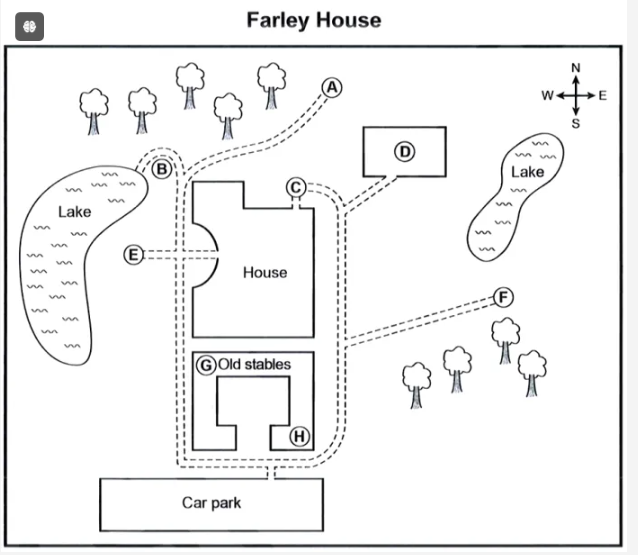
Label the plan below.

Write the correct letter, A-H, next to Questions 16-20

Branley Castle

Branley Castle plan

16 Starting point for walking the walls

17 Bow and arrow display

18 Hunting birds display

19 Traditional dancing

20 Shop

SECTION 3 Audio

SECTION 3

Questions 21-24

Choose the correct letter, A, B or C.

Woolly mammoths on St Paul’s Island

21 How will Rosie and Martin introduce their presentation?

A with a drawing of woolly mammoths in their natural habit
B with a timeline showing when woolly mammoths lived
C with a video clip about woolly mammoths

22 What was surprising about the mammoth tooth found by Russell Graham?

A It was still embedded in the mammoth’s jawbone.
B It was from an unknown species of mammoth.
C It was not as old as mammoth remains from elsewhere.

23 The students will use an animated diagram to demonstrate how the mammoths

A became isolated on the island.
B spread from the island to other areas.
C coexisted with other animals on the island.

24 According to Martin, what is unusual about the date of the mammoths’ extinction on the island?

A how exact it is
B how early it is
C how it was established

Questions 25-30

What action will the students take for each of the following sections of their presentation?

Choose SIX answers from the box and write the correct letter, A-H, next to Questions 25-30.

Actions
A make it more interactive
B reduce visual input
C add personal opinions
D contact one of the researchers
E make detailed notes
F find information online
G check timing
H organise the content more clearly

25 Introduction

26 Discovery of the mammoth tooth

27 Initial questions asked by the researchers

28 Further research carried out on the island

29 Findings and possible explanations

30 Relevance to the present day

SECTION 4 Audio

SECTION 4

Questions 31-40

Complete the notes below.

Write ONE WORD ONLY for each answer.

The history of weather forecasting

Ancient cultures

• many cultures believed that floods and other disasters were involved in the creation of the world

• many cultures invented 31 and other ceremonies to make the weather gods friendly

• people needed to observe and interpret the sky to ensure their 32

• around 650 BC, Babylonians started forecasting, using weather phenomena such as 33

• by 300 BC, the Chinese had a calendar made up of a number of 34 connected with the weather

Ancient Greeks

• a more scientific approach

• Aristotle tried to explain the formation of various weather phenomena

• Aristotle also described haloes and 35

Middle Ages

• Aristotle’s work considered accurate

• many proverbs, e.g. about the significance of the colour of the 36 , passed on accurate information.

15th-19th centuries

• 15th century: scientists recognised value of 37 for the first time

• Galileo invented the 38

• Pascal showed relationship between atmospheric pressure and altitude

• from the 17th century, scientists could measure atmospheric pressure and temperature

• 18th century: Franklin identified the movement of 39

• 19th century: data from different locations could be sent to the same place by 40

Cambridge 14 Test 3 Listening

CAMBRIDGE 14 TEST 3 LISTENING

SECTION 1 Audio

SECTION 1

Questions 1-10

Complete the notes below.

Write ONE WORD AND/OR A NUMBER for each answer.

Flanders Conference Hotel

Example

Customer Services Manager: …………Angela………..

Date available

● weekend beginning February 4th

Conference facilities

● the 1 room for talks
   (projector and 2 available)

● area for coffee and an 3

● free 4 throughout

● a standard buffet lunch costs 5 $ per head

Accommodation

● Rooms will cost 6 $ including breakfast.

Other facilities

● The hotel also has a spa and rooftop 7

● There’s a free shuttle service to the 8

Location

● Wilby Street (quite near the 9 )

● near to restaurants and many 10

SECTION 2 Audio

SECTION 2

Questions 11 and 12

Choose TWO letters, A-E.

Which TWO activities that volunteers do are mentioned?

Questions 13 and 14

Choose TWO letters, A-E.

Which TWO ways that volunteers can benefit from volunteering are mentioned?

Questions 15-20

What has each of the following volunteers helped someone to do?

Choose SIX answers from the box and write the correct letter, A-G, next to Questions 15-20.

What volunteers have helped people to do
A overcome physical difficulties
B rediscover skills not used for a long time
C improve their communication skills
D solve problems independently
E escape isolation
F remember past times
G start a new hobby

15 Habib

16 Consuela

17 Minh

18 Tanya

19 Alexei

20 Juba

SECTION 3 Audio

SECTION 3

Questions 21-26

Complete the notes below.

Write ONE WORD AND/OR A NUMBER for each answer.

Background on school marching band

It consists of around 21 students.

It is due to play in a 22 band competition.

It has been invited to play in the town’s 23 .

They have listened to a talk by a 24 .

Joe will discuss a 25 with the band.

Joe hopes the band will attend a 26 next month.

Questions 27-30

What problem does Joe mention in connection with each of the following band members?

Choose FOUR answers from the box and write the correct letter, A-F, next to Questions 27-30.

Problems
A makes a lot of mistakes in rehearsals
B keeps making unhelpful suggestions
C has difficulty with rhythm
D misses too many rehearsals
E has a health problem
F doesn’t mix with other students

27 flautist

28 trumpeter

29 trombonist

30 percussionist

SECTION 4 Audio

SECTION 4

Questions 31-40

Complete the notes below.

Write ONE WORD AND/OR A NUMBER for each answer.

Concerts in university arts festival

Concert 1

Australian composer: Liza Lim

studied piano and 31 before turning to composition

performers and festivals around the world have given her a lot of commissions

compositions show a great deal of 32 and are drawn from various cultural sources

her music is very expressive and also 33

festival will include her 34 called The Oresteia

Lim described the sounds in The Oresteia as 35

British composers: Ralph Vaughan Williams, Frederick Delius

Concert 2

British composers: Benjamin Britten, Judith Weir

Australian composer: Ross Edwards

festival will include The Tower of Remoteness, inspired by nature

The Tower of Remoteness is performed by piano and 36

compositions include music for children

celebrates Australia’s cultural 37

Concert 3

Australian composer: Carl Vine

played cornet then piano

studied 38 before studying music

worked in Sydney as a pianist and composer

became well known as composer of music for 39

festival will include his music for the 1996 40

British composers: Edward Elgar, Thomas Adès

Cambridge 14 Test 4 Listening

CAMBRIDGE 14 TEST 4 LISTENING

SECTION 1 Audio

SECTION 1

Questions 1-7

Complete the notes below.

Write ONE WORD AND/OR A NUMBER for each answer.

Enquiry about booking hotel room for event

Example
Andrew is the ……Events…… Manager

Rooms

Adelphi Room
number of people who can sit down to eat: 1
has a gallery suitable for musicians
can go out and see the 2 in pots on the terrace
terrace has a view of a group of 3

Carlton Room
number of people who can sit down to eat: 110
has a 4
View of the lake

Options

Master of Ceremonies:
can give a 5 while people are eating
will provide 6 if there are any problems

Accommodation:
in the hotel rooms or 7

Questions 8-10

Choose A, B or C.

A included in cost of hiring room
B available at extra charge
C not available

8 outdoor swimming pool

9 gym

10 tennis courts

SECTION 2 Audio

SECTION 2

Questions 11-16

Choose SIX answers from A-H.

A all downhill
B suitable for beginners
C only in good weather
D food included
E no charge
F swimming possible
G fully booked today
H transport not included

11 dolphin watching

12 forest walk

13 cycle trip

14 local craft tour

15 observatory trip

16 horse riding

Questions 17 and 18

Choose TWO letters, A-E.

Which TWO things does the speaker say about Musical Favourites?

Questions 19 and 20

Choose TWO letters, A-E.

Which TWO things does the speaker say about the Castle Feast?

SECTION 3 Audio

SECTION 3

Questions 21-25

Choose the correct letter, A, B or C.

21 What does Trevor find interesting about the purpose of children’s literature?

A the fact that authors may not realise what values they’re teaching
B the fact that literature can be entertaining and educational at the same time
C the fact that adults expect children to imitate characters in literature

22 Trevor says the module made him

A analyse some stories his niece reads.
B wonder how far popularity reflects good quality.
C decide to start writing children’s stories.

23 Stephanie is interested in the Pictures module because

A she intends to become an illustrator.
B she can remember beautiful illustrations from childhood.
C she believes illustrations are more important than words.

24 Trevor and Stephanie agree that comics

A are inferior to books.
B have the potential for being useful.
C discourage children from using imagination.

25 Regarding books aimed only at boys or girls, Trevor was surprised

A how long the distinction had gone unquestioned.
B how few books were aimed at both.
C how many children enjoyed books for the opposite sex.

Questions 26-30

Choose FIVE answers from A-G.

A translated into many other languages
B hard to read
C inspired a work in a different area of art
D more popular than the author’s other works
E original title refers to another book
F started a new genre
G unlikely topic

26 Perrault’s fairy tales

27 The Swiss Family Robinson

28 The Nutcracker and the Mouse King

29 The Lord of the Rings

30 War Horse

SECTION 4 Audio

SECTION 4

Questions 31-40

Complete the notes below.

Write ONE WORD ONLY for each answer.

The hunt for sunken settlements and ancient shipwrecks

ATLIT-YAM
• had a semicircle of large stones round a 31
• research carried out into structures, 32 and human remains

TRADITIONAL AUTONOMOUS UNDERWATER VEHICLES (AUVs)
• used in the oil industry, e.g. to make 33
• problems: they were expensive and 34

LATEST AUVs
• Marzamemi, Sicily: found ancient Roman ships carrying architectural elements made of 35

Underwater internet:
• 36 is used for short distance communication, acoustic waves for long distance
• AUV can send data to another AUV that has better 37 , for example

Planned research in Gulf of Baratti:
• one carrying 38 supplies; tablets may have been used for cleaning the 39
• others carrying containers of olive oil or 40

Cambridge 15 Test 1 Listening

CAMBRIDGE 15 TEST 1 LISTENING

Listening Audio - PART 1

PART 1

Questions 1 – 10

Complete the notes below.

Write ONE WORD AND/OR A NUMBER for each answer.

Bankside Recruitment Agency

●   Address of agency: 497 Eastside, Docklands

●   Name of agent: Becky 1

●   Phone number: 07866 510333

●   Best to call her in the 2

Typical jobs

●   Clerical and admin roles, mainly in the finance industry

●   Must have good 3 skills

●   Jobs are usually for at least one 4

●   Pay is usually 5 £ per hour

Registration process

●   Wear a 6 to the interview

●   Must bring your 7 to the interview

●   They will ask questions about each applicant’s 8

Advantages of using an agency

●   The 9 you receive at interview will benefit you

●   Will get access to vacancies which are not advertised

●   Less 10 is involved in applying for jobs

Listening Audio - PART 2

PART 2

Questions 11 – 14

Choose the correct letter, A, B or C.

Matthews Island Holidays

11   According to the speaker, the company

A   has been in business for longer than most of its competitors.

B   arranges holidays to more destinations than its competitors.

C   has more customers than its competitors.

12   Where can customers meet the tour manager before travelling to the Isle of Man?

A   Liverpool

B   Heysham

C   Luton

13   How many lunches are included in the price of the holiday?

A   three

B   four

C   five

14   Customers have to pay extra for

A   guaranteeing themselves a larger room.

B   booking at short notice.

C   transferring to another date.

Questions 15-20

Complete the table below.

Write ONE WORD AND/OR A NUMBER for each answer.

Timetable for Isle of Man holiday

ActivityNotes
Day 1ArriveIntroduction by manager

Hotel dining room has view of the 15
Day 2Tynwald Exhibition and PeelTynwald may have been founded in 16 not 979.
Day 3Trip to SnaefellTravel along promenade in a tram; train to Laxey; train to the 17 of Snaefell
Day 4Free dayCompany provides a 18 for local transport and heritage sites.
Day 5Take the 19 railway train from Douglas to Port ErinFree time, then coach to Castletown – former 20 has old castle.
Day 6LeaveLeave the island by ferry or plane

Listening Audio - PART 3

PART 3

Questions 21 – 26

What did findings of previous research claim about the personality traits a child is likely to have because of their position in the family?

Choose SIX answers from the box and write the correct letter, A-H, next to Questions 21-26

Personality Traits

A      outgoing

B      selfish

C      independent

D      attention-seeking

E      introverted

F      co-operative

G      caring

H      competitive

Position in family

21   the eldest child

22   a middle child

23   the youngest child

24   a twin

25   an only child

26   a child with much older siblings

Questions 27 and 28

Choose the correct letter, A, B or C.

27   What do the speakers say about the evidence relating to birth order and academic success?

A   There is conflicting evidence about whether oldest children perform best in intelligence tests.

B   There is little doubt that birth order has less influence on academic achievement than socio-economic status.

C   Some studies have neglected to include important factors such as family size.

28   What does Ruth think is surprising about the difference in oldest children’s academic performance?

A   It is mainly thanks to their roles as teachers for their younger siblings.

B   The advantages they have only lead to a slightly higher level of achievement.

C   The extra parental attention they receive at a young age makes little difference.

Questions 29 and 30

Choose TWO letters, A-E.

Which TWO experiences of sibling rivalry do the speakers agree has been valuable for them?

Listening Audio - PART 4

PART 4

Questions 31 – 40

Complete the notes below.

Write ONE WORD ONLY for each answer.

The Eucalyptus Tree in Australia

Importance

●   it provides 31 and food for a wide range of species

●   its leaves provide 32 which is used to make a disinfectant

Reasons for present decline in number

A) Diseases

(i)   ‘Mundulla Yellows’

●   Cause    – lime used for making 33 was absorbed
                     – trees were unable to take in necessary iron through their roots

(ii)   ‘Bell-miner Associated Die-back’

●   Cause    – 34 feed on eucalyptus leaves
                     – they secrete a substance containing sugar
                     – bell-miner birds are attracted by this and keep away other species

B) Bushfires

William Jackson’s theory:

●   high-frequency bushfires have impact on vegetation, resulting in the growth of 35

●   mid-frequency bushfires result in the growth of eucalyptus forests, because they:
      – make more 36 available to the trees
      – maintain the quality of the 37

●   low-frequency bushfires result in the growth of 38 ‘ rainforest’, which is:
      – a 39 Ecosystem
      – an ideal environment for the 40 of the bell-miner

Cambridge 15 Test 2 Listening

CAMBRIDGE 15 TEST 2 LISTENING

PART 1 Audio

PART 1

Questions 1 – 4

Complete the table below.

Write ONE WORD ONLY for each answer.

Festival information

DateType of eventDetails
17tha concertperformers from Canada
18tha balletcompany called 1
19th-20th (afternoon)a playtype of play: a comedy called Jemima has had a good 2
20th (evening)a 3 showshow is called 4

Questions 5-10

Complete the notes below.

Write ONE WORD ONLY for each answer.

Workshops

●   Making 5 food

●   (children only) Making 6

●   (adults only) Making toys from 7 using various tools

Outdoor activities

●   Swimming in the 8

●   Walking in the woods, led by an expert on 9

See the festival organiser’s 10 for more information

PART 2 Audio

PART 2

Questions 11 – 14

Choose the correct letter, A, B or C.

Minster Park

11   The park was originally established

A   as an amenity provided by the city council.
B   as land belonging to a private house.
C   as a shared area set up by the local community.

12   Why is there a statue of Diane Gosforth in the park?

A   She was a resident who helped to lead a campaign.
B   She was a council member responsible for giving the public access.
C   She was a senior worker at the park for many years.

13   During the First World War, the park was mainly used for

A   exercises by troops.
B   growing vegetables.
C   public meetings.

14   When did the physical transformation of the park begin?

A   2013
B   2015
C   2016

Questions 15-20

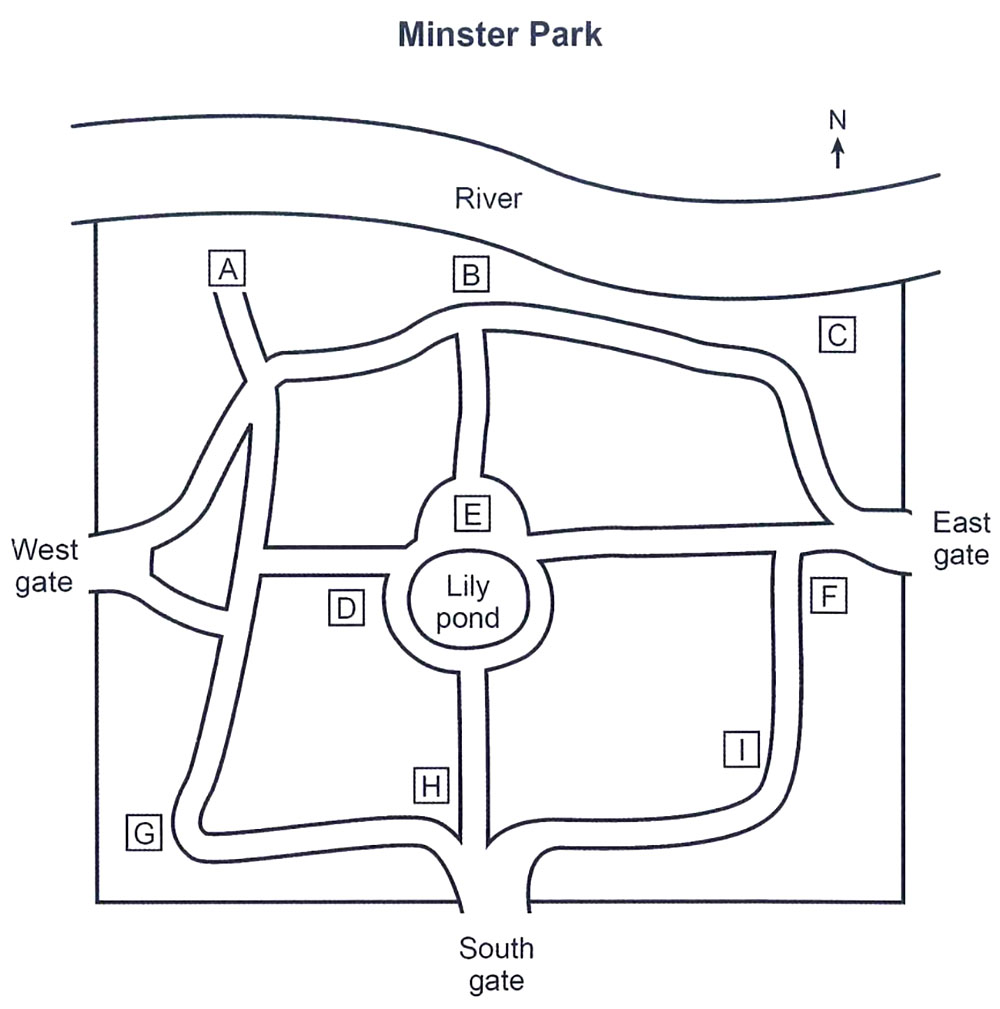
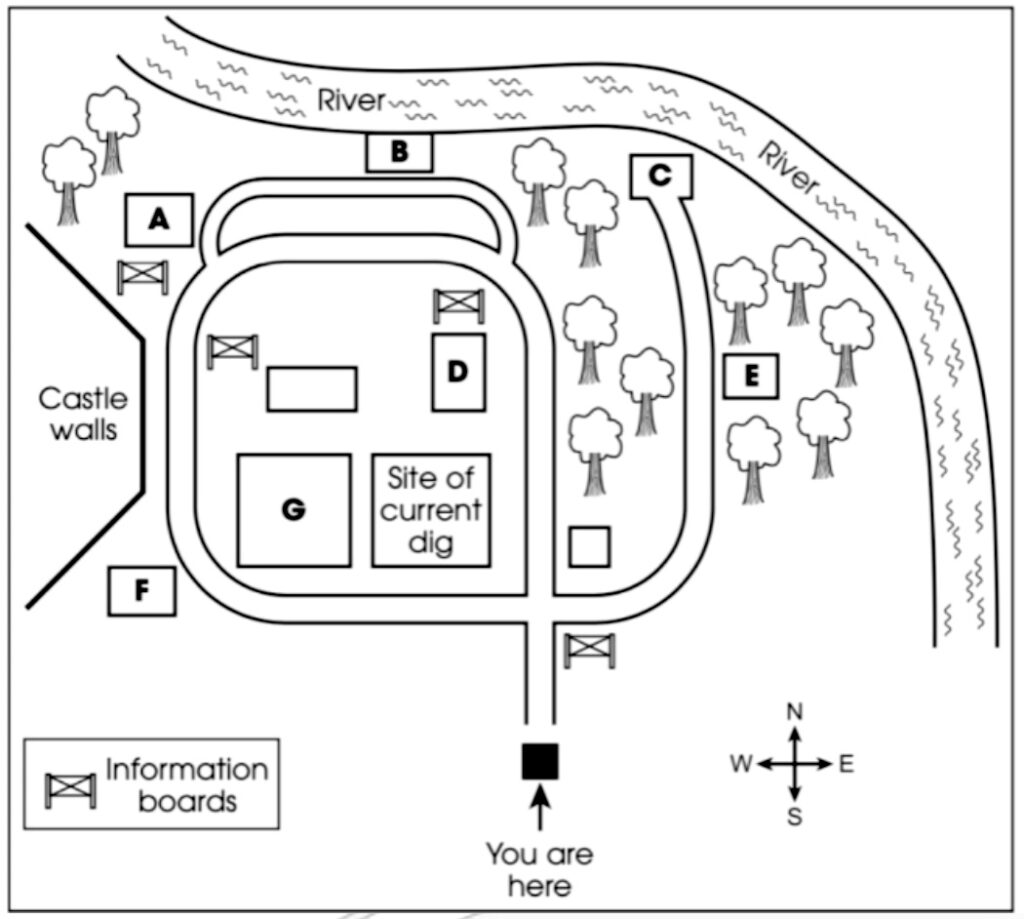
Label the map below.

Write the correct letter, A-I, next to Questions 15-20.

Minster Park map

15   statue of Diane Gosforth

16   wooden sculptures

17   playground

18   maze

19   tennis courts

20   fitness area

PART 3 Audio

PART 3

Questions 21 and 22

Choose TWO letters, A-E.

Which TWO groups of people is the display primarily intended for?

Questions 23 and 24

Choose TWO letters, A-E.

What are Cathy and Graham’s TWO reasons for choosing the novelist Charles Dickens?

Questions 25-30

What topic do Cathy and Graham choose to illustrate with each novel?

Choose SIX answers from the box and write the correct letter, A-H, next to Questions 25-30.

Topics

A   poverty
B   education
C   Dickens’s travels
D   entertainment
E   crime and the law
F   wealth
G   medicine
H   a woman’s life

25   The Pickwick Papers

26   Oliver Twist

27   Nicholas Nickleby

28   Martin Chuzzlewit

29   Bleak House

30   Little Dorrit

PART 4 Audio

PART 4

Questions 31 – 40

Complete the notes below.

Write ONE WORD ONLY for each answer.

Agricultural programme in Mozambique

How the programme was organised

●   It focused on a dry and arid region in Chicualacuala district, near the Limpopo River.

●   People depended on the forest to provide charcoal as a source of income.

●   31 was seen as the main priority to ensure the supply of water.

●   Most of the work organised by farmers’ associations was done by 32

●   Fenced areas created to keep animals away from crops.

●   The programme provided
    –  33 for the fences
    –  34 for suitable crops
    –  water pumps.

●   The farmers provided
    –  labour
    –  35 for the fences on their land.

Further developments

●   The marketing of produce was sometimes difficult due to lack of 36 .

●   Training was therefore provided in methods of food 37 .

●   Farmers made special places where 38 could be kept.

●   Local people later suggested keeping 39 .

Evaluation and lessons learned

●   Agricultural production increased, improving incomes and food security.

●   Enough time must be allowed, particularly for the 40 phase of the programme.

Cambridge 15 Test 3 Listening

CAMBRIDGE 15 TEST 3 LISTENING

PART 1 Audio

PART 1

Questions 1 – 10

Complete the notes below.

Write ONE WORD AND/OR A NUMBER for each answer.

Employment Agency: Possible Jobs

First Job

Administrative assistant in a company that produces 1 (North London)

Responsibilities

●   data entry

●   go to 2 and take notes

●   general admin

●   management of 3

Requirements

●   good computer skills including spreadsheets

●   good interpersonal skills

●   attention to 4

Experience

●   need a minimum of 5 of experience of teleconferencing

Second Job

Warehouse assistant in South London

Responsibilities

●   stock management

●   managing 6

Requirements

●   ability to work with numbers

●   good computer skills

●   very organised and 7

●   good communication skills

●   used to working in a 8

●   able to cope with items that are 9

Need experience of

●   driving in London

●   warehouse work

●   10 service

PART 2 Audio

PART 2

Questions 11 – 16

Choose the correct letter, A, B or C.

Street Play Scheme

11   When did the Street Play Scheme first take place?

A   two years ago
B   three years ago
C   six years ago

12   How often is Beechwood Road closed to traffic now?

A   once a week
B   on Saturdays and Sundays
C   once a month

13   Who is responsible for closing the road?

A   a council official
B   the police
C   local wardens

14   Residents who want to use their cars

A   have to park in another street.
B   must drive very slowly
C   need permission from a warden.

15   Alice says that Street Play Schemes are most needed in

A   wealthy areas
B   quiet suburban areas.
C   areas with heavy traffic.

16   What has been the reaction of residents who are not parents?

A   Many of them were unhappy at first.
B   They like seeing children play in the street.
C   They are surprised by the lack of noise.

Questions 17 and 18

Choose TWO letters, A-E.

Which TWO benefits for children does Alice think are the most important?

Questions 19 and 20

Choose TWO letters, A-E.

Which TWO results of the King Street experiment surprised Alice?

PART 3 Audio

PART 3

Questions 21 – 26

Complete the notes below.

Write ONE WORD ONLY for each answer.

What Hazel should analyse about items in newspapers:

●   what 21 the item is on

●   the 22 of the item, including the headline

●   any 23 accompanying the item

●   the 24 of the item, e.g. what’s made prominent

●   the writer’s main 25

●   the 26 the writer may make about the reader

Questions 27-30

What does Hazel decide to do about each of the following types of articles?

Write the correct letter, A, B or C, next to Questions 27-30

A   She will definitely look for a suitable article.
B   She may look for a suitable article.
C   She definitely won’t look for an article.

27   national news item

28   editorial

29   human interest

30   arts

PART 4 Audio

PART 4

Questions 31 – 40

Complete the notes below.

Write ONE WORD ONLY for each answer.

Early history of keeping clean

Prehistoric times:

●   water was used to wash off 31

Ancient Babylon

●   soap-like material found in 32 cylinders

Ancient Greece:

●   people cleaned themselves with sand and other substances

●   used a strigil – scraper made of 33

●   washed clothes in streams

Ancient Germany and Gaul:

●   used soap to colour their 34

Ancient Rome:

●   animal fat, ashes and clay mixed through action of rain, used for washing clothes

●   from about 312 BC, water carried to Roman 35 by aqueducts

Europe in Middle Ages:

●   decline in bathing contributed to occurrence of 36

●   37 began to be added to soap

Europe from 17th century:

●   1600s: cleanliness and bathing started becoming usual

●   1791: Leblanc invented a way of making soda ash from 38

●   early 1800s: Chevreul turned soapmaking into a 39

●   from 1800s, there was no longer a 40 on soap.

Cambridge 15 Test 4 Listening

CAMBRIDGE 15 TEST 4 LISTENING

PART 1 Audio

PART 1

Questions 1 – 10

Complete the form below.

Write ONE WORD AND/OR A NUMBER for each answer.

Customer Satisfaction Survey

Customer details

Name:     Sophie Bird

Occupation:     1

Reason for travel today:     2

Journey information

Name of station returning to:     3

Type of ticket purchased:     Standard 4 ticket

Cost of ticket:     5 £

When ticket was purchased:     Yesterday

Where ticket was bought:     6

Satisfaction with journey

Most satisfied with:     the wifi

Least satisfied with:     the 7 this morning.

Satisfaction with station facilities

Most satisfied with:     how much 8 was provided

Least satisfied with:     lack of seats, particularly on the 9

Neither satisfied nor dissatisfied with:     the 10 available

PART 2 Audio

PART 2

Questions 11 – 16

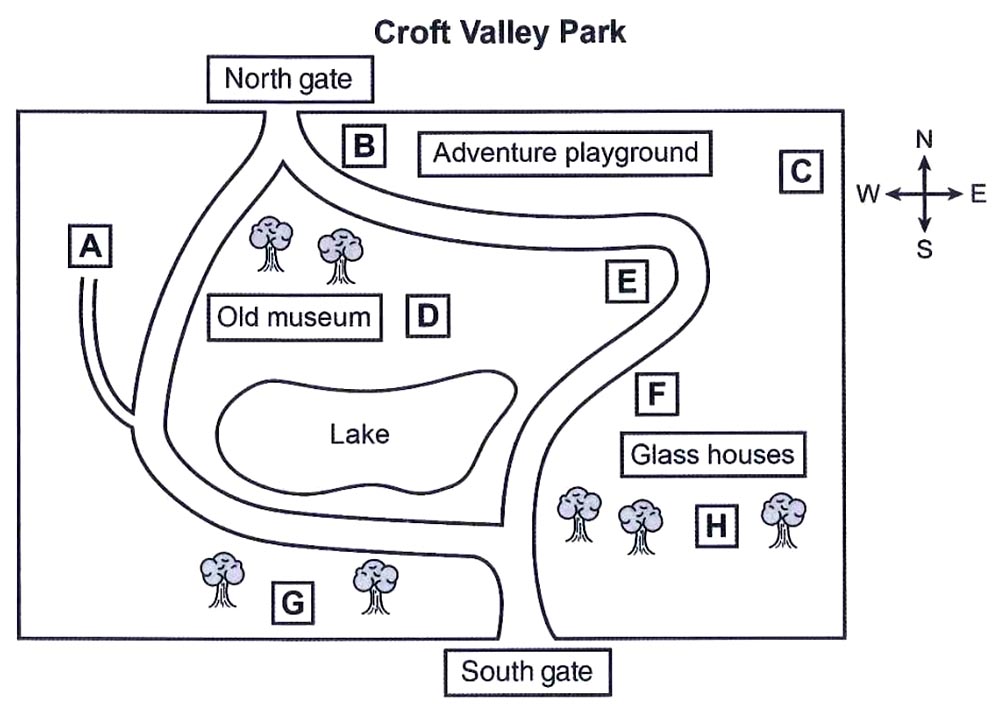
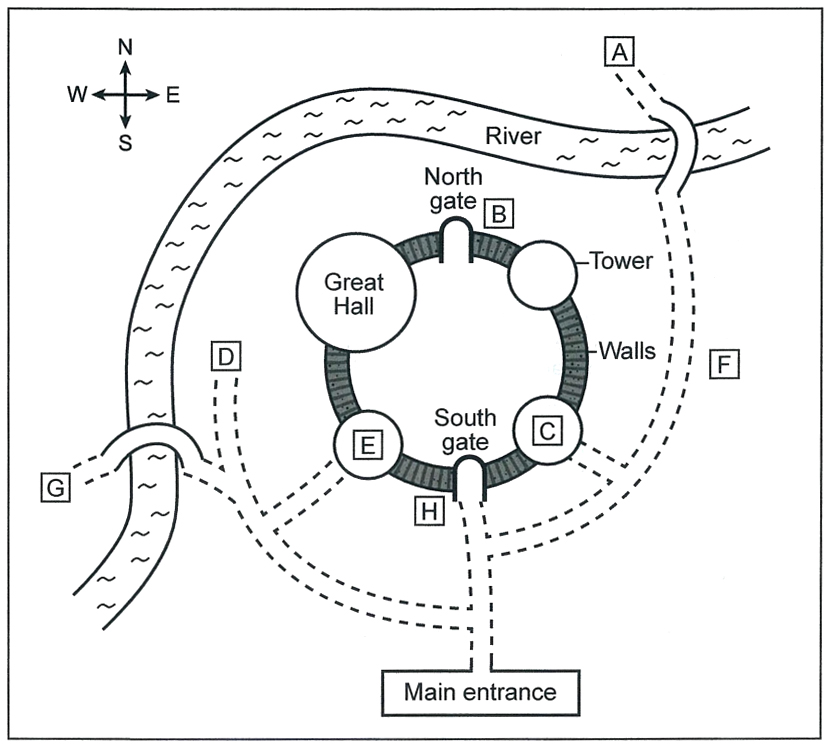
Label the map below.

Write the correct letter, A-H, next to Questions 11-16

Croft Valley Park map

11   café

12   toilets

13   formal gardens

14   outdoor gym

15   skateboard ramp

16   wild flowers

Questions 17 and 18

Choose TWO letters, A-E.

What does the speakers say about the adventure playground?

Questions 19 and 20

What does the speaker say about the glass houses?

PART 3 Audio

PART 3

Questions 21 – 24

Choose the correct letter, A, B or C.

Presentation about refrigeration

21   What did Annie discover from reading about icehouses?

A   why they were first created
B   how the ice was kept frozen
C   where they were located

22   What point does Annie make about refrigeration in ancient Rome?

A   It became a commercial business.
B   It used snow from nearby.
C   It took a long time to become popular.

23   In connection with modern refrigerator, both Annie and Jack are worried about

A   the complexity of the technology.
B   the fact that some are disposed of irresponsibly.
C   the large number that quickly break down.

24   What do Jack and Annie agree regarding domestic fridges?

A   They are generally good value for money.
B   There are plenty of useful variations.
C   They are more useful than other domestic appliances.

Questions 25-30

Who is going to do research into each topic?

Write the correct letter, A, B or C, next to Questions 25-30.

People

A   Annie
B   Jack
C   both Annie and Jack

Topics

25   the goods that are refrigerated

26   the effects on health

27   the impact on food producers

28   the impact on cities

29   refrigerated transport

30   domestic fridges

PART 4 Audio

PART 4

Questions 31 – 40

Complete the notes below.

Write ONE WORD ONLY for each answer.

How the Industrial Revolution affected life in Britain

19th century

●   For the first time, people’s possessions were used to measure Britain’s 31 .

●   Developments in production of goods and in 32 greatly changed lives.

MAIN AREAS OF CHANGE

Manufacturing

●   The Industrial Revolution would not have happened without the new types of 33 that were used then.

●   The leading industry was 34 (its products became widely available).

●   New 35 made factories necessary and so more people moved into towns.

Transport

●   The railways took the place of canals.

●   Because of the new transport:
    –  greater access to 36 Made people more aware of what they could buy in shops.
    –  when shopping, people were not limited to buying 37 goods.

Retailing

●   The first department stores were opened.

●   The displays of goods were more visible:
    –  inside stores because of better 38 .
    –  outside stores, because 39 were bigger.

●   40 that was persuasive became much more common.

Cambridge 16 Test 1 Listening

CAMBRIDGE 16 TEST 1 LISTENING

Listening Audio - PART 1

PART 1

Questions 1 – 10

Complete the notes below.

Write ONE WORD AND/OR A NUMBER for each answer.

Children’s Engineering Workshops

Tiny Engineers (ages 4-5)

Activities

●   Create a cover for an 1 so they can drop it from a height without breaking it.

●   Take part in a competition to build the tallest 2 .

●   Make a 3 powered by a balloon.

Junior Engineers (ages 6-8)

Activities:

●   Build model cars, trucks and 4 and learn how to program them so they can move.

●   Take part in a competition to build the longest 5 using card and wood.

●   Create a short 6 with special software.

●   Build, 7 and program a humanoid robot.

Cost for a five-week block: £50

Held on 8 from 10 am to 11 am

Location

Building 10A, 9 Industrial Estate, Grasford

Plenty of 10 is available.

Listening Audio - PART 2

PART 2

Questions 11 – 14

Choose the correct letter, A, B or C.

11   Stevenson’s was founded in

A   1923.

B   1924.

C   1926.

12   Originally, Stevenson’s manufactured goods for

A   the healthcare industry.

B   the automotive industry.

C   the machine tools industry.

13   What does the speaker say about the company premises?

A   The company has recently moved.

B   The company has no plans to move.

C   The company is going to move shortly.

14   The programme for the work experience group includes

A   time to do research.

B   meetings with a teacher.

C   talks by staff.

Questions 15-20

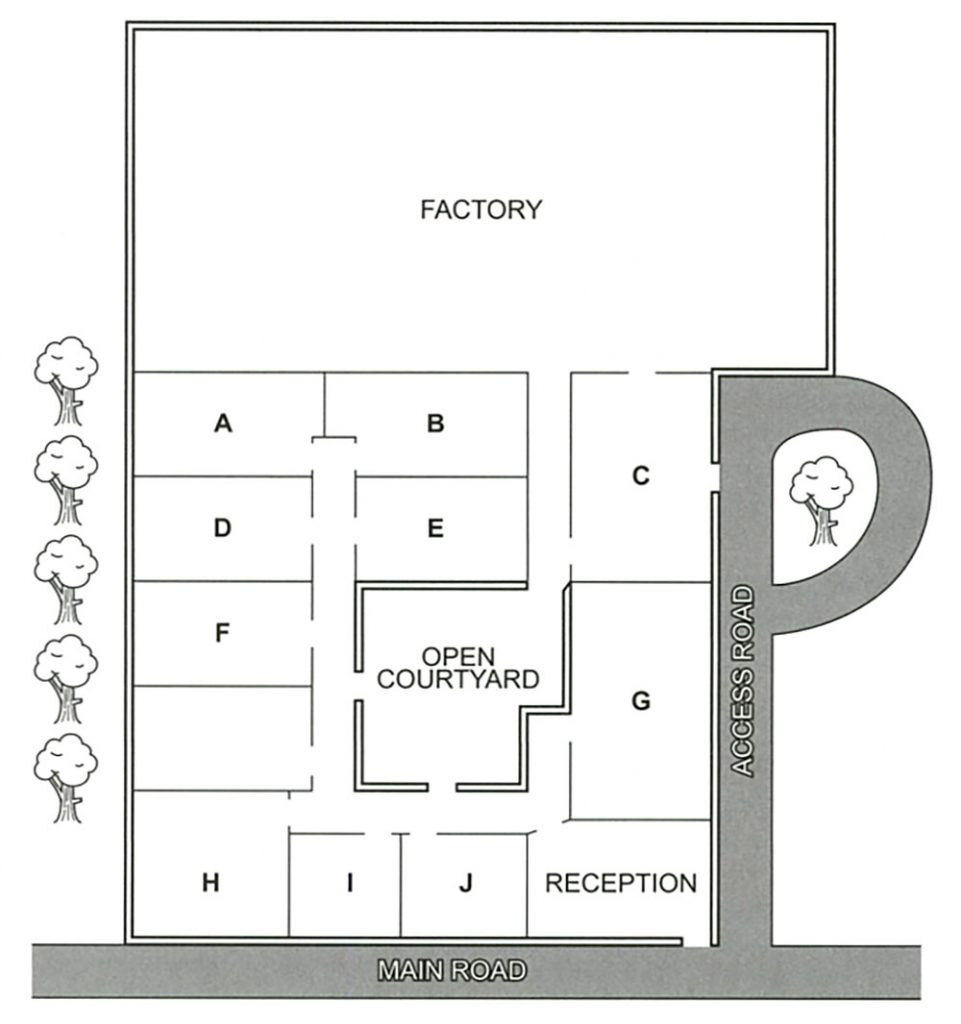
Label the map below.

Write the correct letter, A-J, next to Questions 15-20.

Plan of Stevenson’s site

Plan of Stevenson’s site

15   coffee room            

16   warehouse            

17   staff canteen            

18   meeting room          

19   human resources     

20   boardroom            

Listening Audio - PART 3

PART 3

Questions 21 and 22

Choose TWO letters, A-E.

Which TWO parts of the introductory stage to their art projects do Jess and Tom agree were useful?

Questions 23 and 24

Choose TWO letters, A-E.

In which TWO ways do both Jess and Tom decide to change their proposals?

Questions 25-30

Which personal meaning do the students decide to give to each of the following pictures?

Choose SIX answers from the box and write the correct letter, A-H, next to Questions 25-30.

Personal meanings

A   a childhood memory

B   hope for the future

C   fast movement

D   a potential threat

E   the power of colour

F   the continuity of life

G   protection of nature

H   a confused attitude to nature

Pictures

25   Falcon (Landseer)                                  

26   Fish hawk (Audubon)                             

27   Kingfisher (van Gogh)                        

28   Portrait of William Wells                   

29   Vairumati (Gauguin)                          

30   Portrait of Giovanni de Medici           

Listening Audio - PART 4

PART 4

Questions 31 – 40

Complete the notes below.

Write ONE WORD ONLY for each answer.

Stoicism

Stoicism is still relevant today because of its 31 appeal.

Ancient Stoics

●   Stoicism was founded over 2,000 years ago in Greece.

●   The Stoics’ ideas are surprisingly well known, despite not being intended for 32

Stoic principles

●   Happiness could be achieved by leading a virtuous life.

●   Controlling emotions was essential.

●   Epictetus said that external events cannot be controlled but the 33 people make in response can be controlled.

●   A Stoic is someone who has a different view on experiences which others would consider as 34 .

The influence of Stoicism

●   George Washington organised a 35 about Cato to motivate his men.

●   The French artist Delacroix was a Stoic.

●   Adam Smith’s ideas on 36 were influenced by Stoicism.

●   Some of today’s political leaders are inspired by the Stoics.

●   Cognitive Behaviour Therapy (CBT)

     –  the treatment for 37 is based on ideas from Stoicism

     –  people learn to base their thinking on 38 .

●   In business, people benefit from Stoicism by identifying obstacles as 39 .

Relevance of Stoicism

●   It requires a lot of 40 but Stoicism can help people to lead a good life.

●   It teaches people that having a strong character is more important than anything else.

Cambridge 16 Test 2 Listening

CAMBRIDGE 16 TEST 2 LISTENING

Listening Audio - PART 1

PART 1

Questions 1 – 10

Complete the notes below.

Write ONE WORD AND/OR A NUMBER for each answer.

Copying photos to digital format

Name of company: Picturerep

Requirements

●   Maximum size of photos is 30 cm, minimum size 4 cm.

●   Photos must not be in a 1 or an album.

Cost

●   The cost for 360 photos is 2 £ (including one disk).

●   Before the complete order is sent, 3 is required.

Services included in the price

●   Photos can be placed in a folder, e.g. with the name 4 .

●   The 5 and contrast can be improved if necessary.

●   Photos which are very fragile will be scanned by 6 .

Special restore service (costs extra)

●   It may be possible to remove an object from a photo, or change the 7 .

●   A photo which is not correctly in 8 cannot be fixed.

Other information

●   Orders are completed within 9 .

●   Send the photos in a box (not 10 ).

Listening Audio - PART 2

PART 2

Questions 11 – 15

Choose the correct letter, A, B or C.

Minster Park

11   Dartfield House school used to be

A   a tourist information centre.

B   a private home.

C   a local council building.

12   What is planned with regard to the lower school?

A   All buildings on the main site will be improved.

B   The lower school site will be used for new homes.

C   Additional school buildings will be constructed on the lower school site.

13   The catering has been changed because of

A   long queuing times.

B   changes to the school timetable.

C   dissatisfaction with the menus.

14   Parents are asked to

A   help their children to decide in advance which serving point to use.

B   make sure their children have enough money for food.

C   advise their children on healthy food to eat.

15   What does the speaker say about the existing canteen?

A   Food will still be served there.

B   Only staff will have access to it.

C   Pupils can take their food into it.

Questions 16-18

What comment does the speaker make about each of the following serving points in the Food Hall?

Choose THREE answers from the box and write the correct letter, A-D, next to Questions 16-18.

Comments

A   pupils help to plan menus

B   only vegetarian food

C   different food every week

D   daily change in menu

Food available at serving points in Food Hall

16   World Adventures

17   Street Life

18   Speedy Italian

Questions 19 and 20

Choose TWO letters, A-E.

Which TWO optional after-school lessons are new?

Listening Audio - PART 3

PART 3

Questions 21-24

Choose the correct letter, A, B or C.

Assignment on sleep and dreams

21   Luke read that one reason why we often forget dreams is that

A   our memories cannot cope with too much information.

B   we might other wise be confused about what is real.

C   we do not think they are important.

22   What do Luke and Susie agree about dreams predicting the future?

A   It may just be due to chance.

B   It only happens with certain types of event.

C   It happens more often than some people think.

23   Susie says that a study on pre-school children having a short nap in the day

A   had controversial results.

B   used faulty research methodology.

C   failed to reach any clear conclusions.

24   In their last assignment, both students had problems with

A   statistical analysis.

B   making an action plan.

C   self-assessment

Questions 25-30

Complete the flow chart below.

Write ONE WORD ONLY for each answer.

Assignment plan

Decide on research question:
Is there a relationship between hours of sleep and number of dreams?

Decide on sample:
Twelve students from the 25 department

Decide on methodology:
Self-reporting

Decide on procedure:
Answers on 26

Check ethical guidelines for working with 27
Ensure that risk is assessed and 28 is kept to a minimum

Analyse the results
Calculate the correlation and make a 29

30 the research

Listening Audio - PART 4

PART 4

Questions 31 – 40

Complete the notes below.

Write ONE WORD ONLY for each answer.

Health benefits of dance

Recent findings:

●   All forms of dance produce various hormones associated with feelings of happiness.

●   Dancing with others has a more positive impact than dancing alone.

●   An experiment on university students suggested that dance increases 31 .

●   For those with mental illness, dance could be used as a form of 32 .

Benefits of dance for older people:

●   accessible for people with low levels of 33

●   reduces the risk of heart disease

●   better 34 reduces the risk of accidents

●   improves 35 function by making it work faster

●   improves participants’ general well-being

●   gives people more 36 to take exercise

●   can lessen the feeling of 37 , very common in older people

Benefits of Zumba:

●   A study at The University of Wisconsin showed that doing Zumba for 40 minutes uses up as many 38 as other quite intense forms of exercise.

●   The American Journal of Health Behavior study showed that:

     –  women suffering from 39 benefited from doing Zumba.

     –  Zumba became a 40 for the participants.

Cambridge 16 Test 3 Listening

CAMBRIDGE 16 TEST 3 LISTENING

Listening Audio - PART 1

PART 1

Questions 1 – 10

Complete the notes below.

Write ONE WORD AND/OR A NUMBER for each answer.

JUNIOR CYCLE CAMP

The course focuses on skills and safety

●   Charlie would be placed in Level 5.

●   First of all, children at this level are taken to practise in a 1 .

Instructors

●   Instructors wear 2 shirts.

●   A 3 is required and training is given.

Classes

●   The size of the classes is limited.

●   There are quiet times during the morning for a 4 or a game.

●   Classes are held even if there is 5 .

What to bring

●   a change of clothing

●   a 6

●   shoes (not sandals)

●   Charlie’s 7

Day 1

●   Charlie should arrive at 9.20 am on the first day.

●   Before the class, his 8 will be checked.

●   He should then go to the 9 to meet his class instructor.

Cost

●   The course costs 10 $ per week.

Listening Audio - PART 2

PART 2

Questions 11 and 12

Choose TWO letters, A-E.

According to Megan, what are the TWO main advantages of working in the agriculture and horticulture sectors?

Questions 13 and 14

Choose TWO letters, A-E.

Which TWO of the following are likely to be disadvantages for people working outdoors?

Questions 15-20

What information does Megan give about each of the following job opportunities?

Choose SIX answers from the box and write the correct letter, A-H, next to Questions 15-20.

Information

A   not a permanent job

B   involves leading a team

C   experience not essential

D   intensive work but also fun

E   chance to earn more through overtime

F   chance for rapid promotion

G   accommodation available

H   local travel involved

Job opportunities

15   Fresh food commercial manager

16   Agronomist

17   Fresh produce buyer

18   Garden centre sales manager

19   Tree technician

20   Farm worker

Listening Audio - PART 3

PART 3

Questions 21 and 22

Choose TWO letters, A-E.

Which TWO points does Adam make about his experiment on artificial sweeteners?

Questions 23 and 24

Choose TWO letters, A-E.

Which TWO problems did Rosie have when measuring the fat content of nuts?

Questions 25-30

Choose the correct letter, A, B or C.

25   Adam suggests that restaurants could reduce obesity if their menus

A   offered fewer options.

B   had more low-calorie foods.

C   were organised in a particular way.

26   The students agree that food manufacturers deliberately

A   make calorie counts hard to understand.

B   fail to provide accurate calorie counts.

C   use ineffective methods to reduce calories.

27   What does Rosie say about levels of exercise in England?

A   The amount recommended is much too low.

B   Most people overestimate how much they do.

C   Women now exercise more than they used to.

28   Adam refers to the location and width of stairs in a train station to illustrate

A   practical changes that can influence people’s behaviour.

B   methods of helping people who have mobility problems.

C   ways of preventing accidents by controlling crowd movement.

29   What do the students agree about including reference to exercise in their presentation?

A   They should probably leave it out.

B   They need to do more research on it.

C   They should discuss this with their tutor.

30   What are the students going to do next for their presentation?

A   prepare some slides for it

B   find out how long they have for it

C   decide on its content and organisation

Listening Audio - PART 4

PART 4

Questions 31 – 40

Complete the notes below.

Write ONE WORD ONLY for each answer.

Hand knitting

Interest in knitting

●   Knitting has a long history around the world.

●   We imagine someone like a 31 knitting.

●   A 32 ago, knitting was expected to disappear.

●   The number of knitting classes is now increasing.

●   People are buying more 33 for knitting nowadays.

Benefits of knitting

●   gives support in times of 34 difficulty

●   requires only 35 skills and little money to start

●   reduces stress in a busy life

Early knitting

●   The origins are not known.

●   Findings show early knitted items to be 36 in shape.

●   The first needles were made of natural materials such as wood and 37 .

●   Early yarns felt 38 to touch.

●   Wool became the most popular yarn for spinning.

●   Geographical areas had their own 39 of knitting.

●   Everyday tasks like looking after 40 were done while knitting.

Cambridge 16 Test 4 Listening

CAMBRIDGE 16 TEST 4 LISTENING

PART 1

PART 1

Questions 1 – 10

Complete the notes below.

Write ONE WORD AND/OR A NUMBER for each answer.

Holiday rental

Owner’s names: Jack Fitzgerald and Shirley Fitzgerald

Granary Cottage

●   available for week beginning 1 May

●   cost for the week: 2 £

3 Cottage

●   cost for the week: £480

●   building was originally a 4

●   walk through doors from living room into a 5

●   several 6 spaces at the front

●   bathroom has a shower

●   central heating and stove that burns 7

●   views of old 8 from living room

●   view of hilltop 9 from the bedroom

Payment

●   deposit: £144

●   deadline for final payment: end of 10

PART 2

PART 2

Questions 11-14

Choose the correct letter, A, B or C.

Local council report on traffic and highways

11   A survey found people’s main concern about traffic in the area was

A   cuts to public transport.
B   poor maintenance of roads.
C   changes in the type of traffic.

12   Which change will shortly be made to the cycle path next to the river?

A   It will be widened.
B   It will be extended.
C   It will be resurfaced.

13   Plans for a pedestrian crossing have been postponed because

A   the Post Office has moved.
B   the proposed location is unsafe.
C   funding is not available at present.

14   On Station Road, notices have been erected

A   telling cyclists not to leave their bikes outside the station ticket office.
B   asking motorists to switch off engines when waiting at the level crossing.
C   warning pedestrians to leave enough time when crossing the railway line.

Questions 15-20

Label the map below.

Write the correct letter, A-I, next to Questions 15-20.

Recreation ground after proposed changes

Recreation ground after proposed changes

15   New car park

16   New cricket pitch

17   Children’s playground

18   Skateboard ramp

19   Pavilion

20   Notice board

PART 3

PART 3

Questions 21-22

Choose TWO letters, A-E.

Which TWO benefits of city bike-sharing schemes do the students agree are the most important?

Questions 23-24

Choose TWO letters, A-E.

Which TWO things do the students think are necessary for successful bike-sharing schemes?

Questions 25-30

What is the speakers’ opinion of the bike-sharing schemes in each of the following cities?

Choose SIX answers from the box and write the correct letter, A-G, next to Questions 25-30.

Opinion of bike-sharing scheme

A   They agree it has been disappointing.

B   They think it should be cheaper.

C   They are surprised it has been so successful.

D   They agree that more investment is required.

E   They think the system has been well designed.

F   They disagree about the reasons for its success.

G   They think it has expanded too quickly.

Cities

25   Amsterdam

26   Dublin

27   London

28   Buenos Aires

29   New York

30   Sydney

PART 4

PART 4

Questions 31 – 40

Complete the notes below.

Write ONE WORD ONLY for each answer.

THE EXTINCTION OF THE DODO BIRD

The dodo was a large flightless bird which used to inhabit the island of Mauritius.

History

●   1507 – Portuguese ships transporting 31 stopped at the island to collect food and water.

●   1638 – The Dutch established a 32 on the island.

●   They killed the dodo birds for their meat.

●   The last one was killed in 1681.

Description

●   The only record we have is written descriptions and pictures (possibly unreliable).

●   A Dutch painting suggests the dodo was very 33 .

●   The only remaining soft tissue is a dried 34 .

●   Recent studies of a dodo skeleton suggest the birds were capable of rapid 35 .

●   It’s thought they were able to use their small wings to maintain 36 .

●   Their 37 was of average size.

●   Their sense of 38 enabled them to find food.

Reasons for extinction

●   Hunting was probably not the main cause.

●   Sailors brought dogs and monkeys.

●   39 also escaped onto the island and ate the birds’ eggs.

●   The arrival of farming meant the 40 was destroyed.

Cambridge 17 Test 1 Listening

CAMBRIDGE 17 TEST 1 LISTENING

Listening Audio

PART 1

Questions 1 – 10

Complete the notes below.

Write ONE WORD AND/OR A NUMBER for each answer.

Buckworth Conservation Group

Regular activities

Beach

● making sure the beach does not have on it

● no

Nature reserve

● maintaining paths

● nesting boxes for birds installed

● next task is taking action to attract to the place

● identifying types of

● building a new

Forthcoming events

Saturday

● meet at Dunsmore Beach car park

● walk across the sands and reach the

● take a picnic

● wear appropriate

Woodwork session

● suitable for to participate in

● making out of wood

● 17th, from 10 a.m. to 3 p.m.

● cost of session (no camping): £

PART 2

Questions 11–14

Choose the correct letter, A, B or C.

Boat trip round Tasmania

11 What is the maximum number of people who can stand on each side of the boat?

A 9

B 15

C 18

12 What colour are the tour boats?

A dark red

B jet black

C light green

13 Which lunchbox is suitable for someone who doesn’t eat meat or fish?

A Lunchbox 1

B Lunchbox 2

C Lunchbox 3

14 What should people do with their litter?

A take it home

B hand it to a member of staff

C put it in the bins provided on the boat

Questions 15 and 16

Choose TWO letters, A–E.

Which TWO features of the lighthouse does Lou mention?

Questions 17 and 18

Choose TWO letters, A–E.

Which TWO types of creature might come close to the boat?

Questions 19 and 20

Choose TWO letters, A–E.

Which TWO points does Lou make about the caves?

PART 3

Questions 21-26

Choose the correct letter, A, B or C.

Work experience for veterinary science students

21 What problem did both Diana and Tim have when arranging their work experience?

A make initial contact with suitable farms

B organising transport to and from the farm

C finding a placement for the required length of time

22 Tim was pleased to be able to help

A a lamb that had a broken leg.

B a sheep that was having difficult giving birth.

C a newly born lamb that was having trouble feeding.

23 Diana says the sheep on her farm

A were of various different varieties.

B were mainly reared for their meat.

C had better quality wool than sheep on the hills.

24 What did the students learn about adding supplements to chicken feed?

A These should only be given if specially needed.

B It is worth paying extra for the most effective ones.

C The amount given at one time should be limited.

25 What happened when Diana was working with dairy cows?

A She identified some cows incorrectly.

B She accidentally threw some milk away.

C She made a mistake when storing milk.

26 What did both farmers mention about vets and farming?

A Vets are failing to cope with some aspects of animal health.

B There needs to be a fundamental change in the training of vets.

C Some jobs could be done by the farmer rather than by a vet.

Questions 27-30

What opinion do the students give about each of the following modules on their veterinary science course?

Choose FOUR answers from the box and write the correct letter, A-F, next to questions 27-30.

Opinions

A Tim found this easier than expected.

B Tim thought this was not very clearly organised.

C Diana may do some further study on this.

D They both found the reading required for this was difficult.

E Tim was shocked at something he learned on this module.

F They were both surprised how little is known about some aspects of this.

Modules on Veterinary Science course

27 Medical terminology

28 Diet and nutrition

29 Animal disease

30 Wildlife medication

PART 4

Questions 31 – 40

Complete the notes below.

Write ONE WORD ONLY for each answer.

Labyrinths

Definition

● a winding spiral path leading to a central area

Labyrinths compared with mazes

● Mazes are a type of

is needed to navigate through a maze

– the word ‘maze’ is derived from a word meaning a feeling of

● Labyrinths represent a journey through life

– they have frequently been used in and prayer

Early examples of the labyrinth spiral

● Ancient carvings on have been found across many cultures

● The Pima, a Native American tribe, wove the symbol on baskets

● Ancient Greeks used the symbol on

Walking labyrinths

● The largest surviving example of a turf labyrinth once had a big at its centre

Labyrinths nowadays

● Believed to have a beneficial impact on mental and physical health, e.g., walking a maze can reduce a person’s rate

● Used in medical and health and fitness settings and also prisons

● Popular with patients, visitors and staff in hospitals

– patients who can’t walk can use ‘finger labyrinths’ made from

– research has shown that Alzheimer’s sufferers experience less

Cambridge 17 Test 2 Listening

CAMBRIDGE 17 TEST 2 LISTENING

Listening Audio

PART 1

Questions 1 – 7

Complete the notes below.

Write ONE WORD ONLY for each answer.

Opportunities for voluntary work in Southoe village

Library

● Help with books (times to be arranged)

● Help needed to keep of books up to date

● Library is in the Room in the village hall

Lunch club

● Help by providing

● Help with hobbies such as

Help for individuals needed next week

● Taking Mrs Carroll to

● Work in the at Mr Selsbury’s house

Questions 8-10

Complete the table below.

Write ONE WORD ONLY for each answer.

Village social events

19 Oct Village hall providing refreshments

18 Nov dance Village hall checking

31 Dec New Year’s Eve party Mountfort Hotel designing the

PART 2

Questions 11 – 14

Choose the correct letter, A, B or C.

Oniton Hall

11 Many past owners made changes to

A the gardens.

B the house.

C the farm.

12 Sir Edward Downes built Oniton Hall because he wanted

A a place for discussing politics.

B a place to display his wealth.

C a place for artists and writers.

13 Visitors can learn about the work of servants in the past from

A audio guides.

B photographs.

C people in costume.

14 What is new for children at Onion Hall?

A clothes for dressing up

B mini tractors

C the adventure playground

Questions 15-20

Which activity is offered at each of the following locations on the farm?

Choose SIX answers from the box and write the correct letter, A-H, next to Questions 15-20.

Activities

A shopping

B watching cows being milked

C seeing old farming equipment

D eating and drinking

E starting a trip

F seeing rare breeds of animals

G helping to look after animals

H using farming tools

Locations on the farm

15 dairy

16 large barn

17 small barn

18 stables

19 shed

20 parkland

PART 3

Questions 21 and 22

Choose TWO letters, A-E.

Which TWO things do the students agree they need to include in their review of Romeo and Juliet?


Questions 23-27

Which opinion do the speakers give about each of the following aspects of The Emporium’s production of Romeo and Juliet?

Choose FIVE answers from the box and write the correct letter, A-G, next to Questions 23-27

Opinions

A They both expected this to be more traditional.

B They both thought this was original.

C They agree this created the right atmosphere.

D They agree this was a major strength.

E They were both disappointed by this.

F They disagree about why this was an issue.

G They disagree about how this could be improved.

Aspects of the production

23 the set

24 the lighting

25 the costume design

26 the music

27 the actors’ delivery

Questions 28-30

Choose the correct letter, A, B or C.

28 The students think the story of Romeo and Juliet is still relevant for young people today because

A it illustrates how easily conflict can start.

B it deals with problems that families experience.

C it teaches them about relationships.

29 The students found watching Romeo and Juliet in another language

A frustrating.

B demanding.

C moving.

30 Why do the students think Shakespeare’s plays have such international appeal?

A The stories are exciting.

B There are recognisable characters.

C They can be interpreted in many ways.

PART 4

Questions 31 – 40

Complete the notes below.

Write ONE WORD AND/OR A NUMBER for each answer.

The impact of digital technology on the Icelandic language

The Icelandic language

● has approximately speakers

● has a that is still growing

● has not changed a lot over the last thousand years

● has its own words for computer-based concepts, such as web browser and

Young speakers

● are big users of digital technology, such as

● are becoming very quickly

● are having discussions using only English while they are in the at school

● are better able to identify the content of a in English than Icelandic

Technology and internet companies

● write very little in Icelandic because of the small number of speakers and because of how complicated its is

The Icelandic government

● has set up a fund to support the production of more digital content in the language

● believes that Icelandic has a secure future

● is worried that young Icelanders may lose their as Icelanders

● is worried about the consequences of children not being in either Icelandic or English

Cambridge 17 Test 3 Listening

CAMBRIDGE 17 TEST 3 LISTENING

Listening Audio

PART 1

Questions 1 – 10

Complete the notes below.

Write ONE WORD AND/OR A NUMBER for each answer.

Advice on surfing holidays

Jack’s advice

● Recommends surfing for holidays in the summer

● Need to be quite

Irish surfing locations

● County Clare

– Lahinch has some good quality and surf schools

– There are famous cliffs nearby

● County Mayo

– Good surf school at beach

– Surf camp lasts for one

– Can also explore the local by kayak

Weather

● Best month to go:

● Average temperature in summer: approx. degrees

Costs

● Equipment

– Wetsuit and surfboard: euros per day

– Also advisable to hire for warmth

PART 2

Questions 11 – 14

Choose TWO letters, A-E.

Which TWO facts are given about the school’s extended hours childcare service?


Questions 13-15

Choose the correct letter, A, B or C.

13 How much does childcare cost for a complete afternoon session per child?

A £3.50

B £5.70

C £7.20

14 What does the manager say about food?

A Children with allergies should bring their own food.

B Children may bring healthy snacks with them.

C Children are given a proper meal at 5 p.m.

15 What is different about arrangements in the school holidays?

A Children from other schools can attend.

B Older children can attend.

C A greater number of children can attend.

Questions 16-20

What information is given about each of the following activities on offer?

Choose FIVE answers from the box and write the correct letter, A-G, next to Questions 16-20.

Information

A has limited availability

B is no longer available

C is for over 8s only

D requires help from parents

E involves an additional fee

F is a new activity

G was requested by children

Activities

16 Spanish

17 Music

18 Painting

19 Yoga

20 Cooking

PART 3

Questions 21-24

Choose the correct letter, A, B or C.

Holly’s Work Placement Tutorial

21 Holly has chosen the Orion Stadium placement because

A it involves children.

B it is outdoors.

C it sounds like fun.

22 Which aspect of safety does Dr Green emphasise most?

A ensuring children stay in the stadium

B checking the equipment children will use

C removing obstacles in changing rooms

23 What does Dr Green say about the spectators?

A They can be hard to manage.

B They make useful volunteers.

C They shouldn’t take photographs.

24 What has affected the schedule in the past?

A bad weather

B an injury

C extra time

Questions 25-30

What do Holly and her tutor agree is an important aspect of each of the following events management skills?

Choose SIX answers from the box and write the correct letter, A-H, next to Questions 25-30.

Important aspects

A being flexible

B focusing on details

C having a smart appearance

D hiding your emotions

E relying on experts

F trusting your own views

G doing one thing at a time

H thinking of the future

Events management skills

25 Communication

26 Organisation

27 Time management

28 Creativity

29 Leadership

30 Networking

PART 4

Questions 31 – 40

Complete the notes below.

Write ONE WORD ONLY for each answer.

Bird Migration Theory

Most birds are believed to migrate seasonally.

Hibernation theory

● It was believed that birds hibernated underwater or buried themselves in .

● This theory was later disproved by experiments on caged birds.

Transmutation theory

● Aristotle believed birds changed from one species into another in summer and winter.

– In autumn he observed that redstarts experience the loss of and thought they then turned into robins.

– Aristotle’s assumptions were logical because the two species of birds had a similar .

17th century

● Charles Morton popularised the idea that birds fly to the in winter.

Scientific developments

● In 1822, a stork was killed in Germany which had an African spear in its .

– previously there had been no that storks migrate to Africa

● Little was known about the and journeys of migrating birds until the practice of ringing was established.

– It was thought large birds carried small birds on some journeys because they were considered incapable of travelling across huge .

– Ringing depended on what is called the of dead birds.

● In 1931, the first to show the migration of European birds was printed.

Cambridge 17 Test 4 Listening

CAMBRIDGE 17 TEST 4 LISTENING

Listening Audio

PART 1

Questions 1 – 10

Complete the notes below.

Write ONE WORD for each answer.

Easy Life Cleaning Services

Basic cleaning package offered

● Cleaning all surfaces

● Cleaning the throughout the apartment

● Cleaning shower, sinks, toilet etc.

Additional services agreed

● Every week

– Cleaning the

– Ironing clothes – only

● Every month

– Cleaning all the from the inside

– Washing down the

Other possibilities

● They can organise a plumber or an if necessary.

● A special cleaning service is available for customers who are allergic to

Information on the cleaners

● Before being hired, all cleaners have a background check carried out by the

● References are required.

● All cleaners are given for two weeks.

● Customers send a after each visit.

● Usually, each customer has one regular cleaner.

PART 2

Questions 11 – 14

Choose the correct letter, A, B or C.

11 Many hotel managers are unaware that their staff often leave because of

A a lack of training.

B long hours.

C low pay.

12 What is the impact of high staff turnover on managers?

A an increased workload

B low morale

C an inability to meet targets

13 What mistake should managers always avoid?

A failing to treat staff equally

B reorganising shifts without warning

C neglecting to have enough staff during busy periods

14 What unexpected benefit did Dunwich Hotel notice after improving staff retention rates?

A a fall in customer complaints

B an increase in loyalty club membership

C a rise in spending per customer

Questions 15-20

Which way of reducing staff turnover was used in each of the following hotels?

Write the correct letter, A, B or C, next to Questions 15-20.

Ways of reducing staff turnover

A improving relationships and teamwork

B offering incentives and financial benefits

C providing career opportunities

Hotels

15 The Sun Club

16 The Portland

17 Bluewater Hotels

18 Pentlow Hotels

19 Green Planet

20 The Amesbury

PART 3

Questions 21 and 22

Choose TWO letters, A-E.

Which TWO points do Thomas and Jeanne make about Thomas’s sporting activities at school?


Questions 23 and 24

Choose TWO letters, A-E.

Which TWO feelings did Thomas experience when he was in Kenya?


Questions 25-30

What comment do the students make about the development of each of the following items of sporting equipment?

Choose SIX answers from the box and write the correct letter, A-H, next to Questions 25-30.

Comments about the development of the equipment

A It could cause excessive sweating.

B The material was being mass produced for another purpose.

C People often needed to make their own.

D It often had to be replaced.

E The material was expensive.

F It was unpopular among spectators.

G It caused injuries.

H No one ring it liked it at first.

Items of sporting equipment

25 the table tennis bat

26 the cricket helmet

27 the cycle helmet

28 the golf club

29 the hockey stick

30 the football

PART 4

Questions 31 – 40

Complete the notes below.

Write ONE WORD ONLY for each answer.

Maple syrup

What is maple syrup?

● made from the sap of the maple tree

● added to food or used in cooking

● colour described as

● very compared to refined sugar

The maple tree

● has many species

● needs sunny days and cool nights

● maple leaf has been on the Canadian flag since 1964

● needs moist soil but does not need fertiliser as well

● best growing conditions and are in Canada and North America

Early maple sugar producers

● made holes in the tree trunks

● used hot to heat the sap

● used tree bark to make containers for collection

● sweetened food and drink with sugar

Today’s maple syrup

The trees

● Tree trunks may not have the correct until they have been growing for 40 years.

● The changing temperature and movement of water within the tree produces the sap.

The production

● A tap drilled into the trunk and a carries the sap into a bucket.

● Large pans of sap called evaporators are heated by means of a .

● A lot of is produced during the evaporation process.

● ‘Sugar sand’ is removed because it makes the syrup look and affects the taste.

● The syrup is ready for use.

● A huge quantity of sap is needed to make a of maple syrup.

Cambridge 18 Test 1 Listening

CAMBRIDGE 18 TEST 1 LISTENING

Listening Audio

PART 1

Transport survey

1 Postcode:

2 Date of bus journey:

3 Reason for trip: shopping and visit to the

4 Cost of too high

5 Got on bus at Street

6 Bus today was

7 Frequency of buses in the

8 Goes to the by car

9 Dislikes bike because of the

10 Lack of

PART 2

11

12

13

Questions 14 and 15


16 Fundraising

17 Litter collection

18 Playmates

19 Story club

20 First aid

PART 3

21

22

23

24

25

26

Questions 27 and 28


Questions 29 and 30


PART 4

31 damage to in the park

32 same

33 use of

34 reduce

35 turned on their

36 had to be monitored

37 tusks and

38 opportunities

39 poachers and

40 increase in


Cambridge 18 Test 2 Listening

CAMBRIDGE 18 TEST 2 LISTENING

Listening Audio

PART 1

Questions 1–5

Complete the notes below.

Write ONE WORD ONLY for each answer.

Working at Milo’s Restaurants

Benefits

● 1 provided for all staff

● 2 during weekdays at all Milo’s Restaurants

● 3 provided after midnight

Person specification

● must be prepared to work well in a team

● must care about maintaining a high standard of 4

● must have a qualification in 5

Questions 6–10

Complete the table below.

Write ONE WORD AND/OR A NUMBER for each answer.

LocationJob titleResponsibilities includePay and conditions
6 Street Breakfast supervisor Checking portions, etc. are correct
Making sure 7 is clean
Starting salary £ 8 per hour
Start work at 5.30 a.m.
City Road Junior chef Supporting senior chefs
Maintaining stock and organising 9
Annual salary £23,000
No work on a 10 once a month

PART 2

Questions 11 and 12

Choose TWO letters, A–E.

What are the TWO main reasons why this site has been chosen for the housing development?

Questions 13 and 14

Choose TWO letters, A–E.

Which TWO aspects of the planned housing development have people given positive feedback about?

Questions 15–20

Label the map below.

Write the correct letter, A–I, next to Questions 15–20.

Map of the planned housing development, labelled A to I

15 School

16 Sports centre

17 Clinic

18 Community centre

19 Supermarket

20 Playground

PART 3

Questions 21–24

Choose the correct letter, A, B or C.

21 Why do the students think the Laki eruption of 1783 is so important?

A   It was the most severe eruption in modern times.

B   It led to the formal study of volcanoes.

C   It had a profound effect on society.

22 What surprised Adam about observations made at the time?

A   the number of places producing them

B   the contradictions in them

C   the lack of scientific data to support them

23 According to Michelle, what did the contemporary sources say about the Laki haze?

A   People thought it was similar to ordinary fog.

B   It was associated with health issues.

C   It completely blocked out the sun for weeks.

24 Adam corrects Michelle when she claims that Benjamin Franklin

A   came to the wrong conclusion about the cause of the haze.

B   was the first to identify the reason for the haze.

C   supported the opinions of other observers about the haze.

Questions 25 and 26

Choose TWO letters, A–E.

Which TWO issues following the Laki eruption surprised the students?

Questions 27–30

What comment do the students make about the impact of the Laki eruption on the following countries?

Choose FOUR answers from the box and write the correct letter, A–F, next to Questions 27–30.

Comments

A   This country suffered the most severe loss of life.

B   The impact on agriculture was predictable.

C   There was a significant increase in deaths of young people.

D   Animals suffered from a sickness.

E   This country saw the highest rise in food prices in the world.

F   It caused a particularly harsh winter.

Countries

27 Iceland

28 Egypt

29 UK

30 USA

PART 4

Questions 31–40

Complete the notes below.

Write ONE WORD ONLY for each answer.

Pockets

Reason for choice of subject

● They are 31 but can be overlooked by consumers and designers.

Pockets in men’s clothes

● Men started to wear 32 in the 18th century.

● A 33 sewed pockets into the lining of the garments.

● The wearer could use the pockets for small items.

● Bigger pockets might be made for men who belonged to a certain type of 34

Pockets in women’s clothes

● Women’s pockets were less 35 than men’s.

● Women were very concerned about pickpockets.

● Pockets were produced in pairs using 36 to link them together.

● Pockets hung from the women’s 37 under skirts and petticoats.

● Items such as 38 could be reached through a gap in the material.

● Pockets, of various sizes, stayed inside clothing for many decades.

● When dresses changed shape, hidden pockets had a negative effect on the 39 of women.

● Bags called ‘pouches’ became popular, before women carried a 40

Cambridge 18 Test 3 Listening

CAMBRIDGE 18 TEST 3 LISTENING

Listening Audio

PART 1

Questions 1–4

Complete the form below.

Write ONE WORD AND/OR A NUMBER for each answer.

Wayside Camera Club membership form

Name: Dan Green

Email address: dan1068@market.com

Home address: 52 1 Street, Peacetown

Heard about us: from a 2

Reasons for joining: to enter competitions to 3

Type of membership: 4 membership (£30)

Questions 5–10

Complete the table below.

Write NO MORE THAN TWO WORDS for each answer.

Photography competitions

Title of competitionInstructionsFeedback to Dan
5 ‘A scene in the homeThe picture’s composition was not good.
‘Beautiful Sunsets’Scene must show some 6 The 7 was wrong.
8 ‘Scene must show 9 The photograph was too 10 .

PART 2

Questions 11 and 12

Choose TWO letters, A–E.

Which TWO warnings does Dan give about picking mushrooms?

Questions 13 and 14

Choose TWO letters, A–E.

Which TWO ideas about wild mushrooms does Dan say are correct?

Questions 15–20

Choose the correct letter, A, B or C.

15 What advice does Dan give about picking mushrooms in parks?

A   Choose wooded areas.

B   Don’t disturb wildlife.

C   Get there early.

16 Dan says it is a good idea for beginners to

A   use a mushroom app.

B   join a group.

C   take a reference book.

17 What does Dan say is important for conservation?

A   selecting only fully grown mushrooms

B   picking a limited amount of mushrooms

C   avoiding areas where rare mushroom species grow

18 According to Dan, some varieties of wild mushrooms are in decline because there is

A   a huge demand for them from restaurants.

B   a lack of rain in this part of the country.

C   a rise in building developments locally.

19 Dan says that when storing mushrooms, people should

A   keep them in the fridge for no more than two days.

B   keep them in a brown bag in a dark room.

C   leave them for a period after washing them.

20 What does Dan say about trying new varieties of mushrooms?

A   Experiment with different recipes.

B   Expect some to have a strong taste.

C   Cook them for a long time.

PART 3

Questions 21 and 22

Choose TWO letters, A–E.

Which TWO opinions about the Luddites do the students express?

Questions 23 and 24

Choose TWO letters, A–E.

Which TWO predictions about the future of work are the students doubtful about?

Questions 25–30

What comment do the students make about each of the following jobs?

Choose SIX answers from the box and write the correct letter, A–G, next to Questions 25–30.

Comments

A   These jobs are likely to be at risk.

B   Their role has become more interesting in recent years.

C   The number of people working in this sector has fallen dramatically.

D   This job will require more qualifications.

E   Higher disposable income has led to a huge increase in jobs.

F   There is likely to be a significant rise in demand for this service.

G   Both employment and productivity have risen.

Jobs

25 Accountants

26 Hairdressers

27 Administrative staff

28 Agricultural workers

29 Care workers

30 Bank clerks

PART 4

Questions 31–40

Complete the notes below.

Write ONE WORD ONLY for each answer.

Space Traffic Management

A Space Traffic Management system

● is a concept similar to Air Traffic Control, but for satellites rather than planes.

● would aim to set up legal and 31 ways of improving safety.

● does not actually exist at present.

Problems in developing effective Space Traffic Management

● Satellites are now quite 32 and therefore more widespread (e.g. there are constellations made up of 33 of satellites).

● At present, satellites are not required to transmit information to help with their 34 .

● There are few systems for 35 satellites.

● Small pieces of debris may be difficult to identify.

● Operators may be unwilling to share details of satellites used for 36 or commercial reasons.

● It may be hard to collect details of the object’s 37 at a given time.

● Scientists can only make a 38 about where the satellite will go.

Solutions

● Common standards should be agreed on for the presentation of information.

● The information should be combined in one 39 .

● A coordinated system must be designed to create 40 in its users.


Cambridge 18 Test 4 Listening

CAMBRIDGE 18 TEST 4 LISTENING

Listening Audio

PART 1

Questions 1–10

Complete the notes below.

Write ONE WORD AND/OR A NUMBER for each answer.

Job details from employment agency

Role: 1

Location: Fordham 2 Centre

3 Road, Fordham

Work involves

● dealing with enquiries

● making 4 and reorganising them

● maintaining the internal 5

● general administration

Requirements

● 6 (essential)

● a calm and 7 manner

● good IT skills

Other information

● a 8 job – further opportunities may be available

● hours: 7.45 a.m. to 9 p.m. Monday to Friday

● 10 is available onsite

PART 2

Questions 11–14

Choose the correct letter, A, B or C.

11 The museum building was originally

A   a factory.

B   a private home.

C   a hall of residence.

12 The university uses part of the museum building as

A   teaching rooms.

B   a research library.

C   administration offices.

13 What does the guide say about the entrance fee?

A   Visitors decide whether or not they wish to pay.

B   Only children and students receive a discount.

C   The museum charges extra for special exhibitions.

14 What are visitors advised to leave in the cloakroom?

A   cameras

B   coats

C   bags

Questions 15–20

What information does the speaker give about each of the following areas of the museum?

Choose SIX answers from the box and write the correct letter, A–H, next to Questions 15–20.

Information

A   Parents must supervise their children.

B   There are new things to see.

C   It is closed today.

D   This is only for school groups.

E   There is a quiz for visitors.

F   It features something created by students.

G   An expert is here today.

H   There is a one-way system.

Areas of museum

15 Four Seasons

16 Farmhouse Kitchen

17 A Year on the Farm

18 Wagon Walk

19 Bees are Magic

20 The Pond

PART 3

Questions 21 and 22

Choose TWO letters, A–E.

Which TWO educational skills were shown in the video of children doing origami?

Questions 23–27

Which comment do the students make about each of the following children in the video?

Choose FIVE answers from the box and write the correct letter, A–G, next to Questions 23–27.

Comments

A   demonstrated independence

B   asked for teacher support

C   developed a competitive attitude

D   seemed to find the activity calming

E   seemed pleased with the results

F   seemed confused

G   seemed to find the activity easy

Children

23 Sid

24 Jack

25 Naomi

26 Anya

27 Zara

Questions 28–30

Choose the correct letter, A, B or C.

28 Before starting an origami activity in class, the students think it is important for the teacher to

A   make models that demonstrate the different stages.

B   check children understand the terminology involved.

C   tell children not to worry if they find the activity difficult.

29 The students agree that some teachers might be unwilling to use origami in class because

A   they may not think that crafts are important.

B   they may not have the necessary skills.

C   they may worry that it will take up too much time.

30 Why do the students decide to use origami in their maths teaching practice?

A   to correct a particular misunderstanding

B   to set a challenge

C   to introduce a new concept

PART 4

Questions 31–40

Complete the notes below.

Write ONE WORD ONLY for each answer.

Victor Hugo

His novel, Les Misérables

● It has been adapted for theatre and cinema.

● We know more about its overall 31 than about its author.

His early career

● In Paris, his career was successful and he led the Romantic movement.

● He spoke publicly about social issues, such as 32 and education.

● Napoleon III disliked his views and exiled him.

His exile from France

● Victor Hugo had to live elsewhere in 33 .

● He used his income from the sale of some 34 he had written to buy a house on Guernsey.

His house on Guernsey

● Victor Hugo lived in this house until the end of the Empire in France.

● The ground floor contains portraits, 35 and tapestries that he valued.

● He bought cheap 36 made of wood and turned this into beautiful wall carvings.

● The first floor consists of furnished areas with wallpaper and 37 that have a Chinese design.

● The library still contains many of his favourite books.

● He wrote in a room at the top of the house that had a view of the 38 .

● He entertained other writers as well as poor 39 in his house.

● Victor Hugo’s 40 gave ownership of the house to the city of Paris in 1927.

Cambridge 19 Test 1 Listening

CAMBRIDGE 19 TEST 1 LISTENING

Listening Audio

PART 1

Hinchingbrooke Country Park

1 Area: hectares

2 Wetland: lakes, ponds and a

3 Science: Children look at about plants, etc.

4 Geography: use a and compass

5 Leisure and tourism: park’s

6 Music: Children make with natural materials

7 feeling of

8 Children learn new

9 Cost per child: £

10 Adults, such as , free

PART 2

Questions 11–15

Choose the correct letter, A, B or C.

Stanthorpe Twinning Association

11 During the visit to Malatte, in France, members especially enjoyed

A going to a theme park.

B experiencing a river trip.

C visiting a cheese factory.

12 What will happen in Stanthorpe to mark the 25th anniversary of the Twinning Association?

A A tree will be planted.

B A garden seat will be bought.

C A footbridge will be built.

13 Which event raised most funds this year?

A the film show

B the pancake evening

C the cookery demonstration

14 For the first evening with the French visitors host families are advised to

A take them for a walk round the town.

B go to a local restaurant.

C have a meal at home.

15 On Saturday evening there will be the chance to

A listen to a concert.

B watch a match.

C take part in a competition.

Questions 16–20

Label the map below. Write the correct letter, A–H.

Stanthorpe map for Questions 16 to 20

16 Farm shop

17 Disabled entry

18 Adventure playground

19 Kitchen gardens

20 The Temple of the Four Winds

PART 3

Questions 21 and 22

Choose TWO letters, A–E.

Which TWO things did Colin find most satisfying about his bread reuse project?


Questions 23 and 24

Choose TWO letters, A–E.

Which TWO ways do the students agree that touch-sensitive sensors for food labels could be developed in future?


Questions 25–30

What is the students’ opinion about each of the following food trends?

Choose SIX answers from the box and write the correct letter, A–H.

Opinions

A This is only relevant to young people.

B This may have disappointing results.

C This already seems to be widespread.

D Retailers should do more to encourage this.

E More financial support is needed for this.

F Most people know little about this.

G There should be stricter regulations about this.

H This could be dangerous.

Food trends

25 Use of local products

26 Reduction in unnecessary packaging

27 Gluten-free and lactose-free food

28 Use of branded products related to celebrity chefs

29 Development of ghost kitchens

30 Use of mushrooms for health concerns

PART 4

31 stones were once

32 His became an archaeologist

33 dig for

34 lack of

35 Houses were in shape

36 pots used to make

37 support a big

38 during

39 decline in quality

40 increase in


Cambridge 19 Test 2 Listening

CAMBRIDGE 19 TEST 2 LISTENING

Listening Audio

PART 1

Questions 1–6

Complete the form below.

Write ONE WORD AND/OR A NUMBER for each answer.

Guitar Group

Coordinator: Gary

Level:

Place: the

Street

Time: Thursday morning at

Recommended website: ‘The perfect

Questions 7–10

Complete the table below.

Write ONE WORD ONLY for each answer.

7 tuning guitars: using an app or by

8 keeping time while the teacher is

9 often listening to a of a song

10 playing together, then

PART 2

Questions 11–16

Choose the correct letter, A, B or C.

Working as a lifeboat volunteer

11 What made David leave London and move to Northsea?

A He was eager to develop a hobby.

B He wanted to work shorter hours.

C He found his job in website design unsatisfying.

12 The Lifeboat Institution in Northsea was built with money provided by

A a local organisation.

B a local resident.

C the local council.

13 In his health assessment, the doctor was concerned about the fact that David

A might be colour blind.

B was rather short-sighted.

C had undergone eye surgery.

14 After arriving at the lifeboat station, they aim to launch the boat within

A five minutes.

B six to eight minutes.

C eight and a half minutes.

15 As a ‘helmsman’, David has the responsibility of deciding

A who will be the members of his crew.

B what equipment it will be necessary to take.

C if the lifeboat should be launched.

16 As well as going out on the lifeboat, David

A gives talks on safety at sea.

B helps with fundraising.

C recruits new volunteers.

Questions 17 and 18

Choose TWO letters, A–E.

Which TWO things does David say about the lifeboat volunteer training?


Questions 19 and 20

Choose TWO letters, A–E.

Which TWO things does David find most motivating about the work he does?


PART 3

Questions 21–24

Choose the correct letter, A, B or C.

21 At first, Don thought the topic of recycling footwear might be too

A limited in scope.

B hard to research.

C boring for listeners.

22 When discussing trainers, Bella and Don disagree about

A how popular they are among young people.

B how suitable they are for school.

C how quickly they wear out.

23 Bella says that she sometimes recycles shoes because

A they no longer fit.

B she no longer likes them.

C they are no longer in fashion.

24 What did the article say that confused Don?

A Public consumption of footwear has risen.

B Less footwear is recycled now than in the past.

C People dispose of more footwear than they used to.

Questions 25–28

What reasons did the recycling manager give for rejecting footwear, according to the students?

Choose FOUR answers from the box and write the correct letter, A–F.

A one shoe was missing

B the colour of one shoe had faded

C one shoe had a hole in it

D the shoes were brand new

E the shoes were too dirty

F the stitching on the shoes was broken

25 the high-heeled shoes

26 the ankle boots

27 the baby shoes

28 the trainers

Questions 29–30

Choose the correct letter, A, B or C.

29 Why did the project to make ‘new’ shoes out of old shoes fail?

A People believed the ‘new’ pairs of shoes were unhygienic.

B There were not enough good parts to use in the old shoes.

C The shoes in the ‘new’ pairs were not completely alike.

30 Bella and Don agree that they can present their topic

A from a new angle.

B with relevant images.

C in a straightforward way.

PART 4

Questions 31–40

Complete the notes below.

Write ONE WORD ONLY for each answer.

31 known as water bears due to how they

32 a round body

33 claws or for gripping

34 carries both and blood

35 mouth shaped like a

36 very low or high

37 A type of ensures their DNA is not damaged.

38 stay alive in

39 liquids found in moss or

40 not considered to be


Cambridge 19 Test 3 Listening

CAMBRIDGE 19 TEST 3 LISTENING

Listening Audio

PART 1

Questions 1–6

Complete the notes below.

Write ONE WORD AND/OR A NUMBER for each answer.

Local food shops

Where to go

1 Kite Place – near the

2 Fish market: cross the and turn right

3 best to go before pm, earlier than closing time

4 Organic shop called ‘

5 look for the large outside

6 Supermarket: take a minibus, number 289

Questions 7–10

Complete the table below.

Write ONE WORD ONLY for each answer.

7 Fish market: a handful of type of seaweed

8 Organic shop: beans and a for dessert

9 Organic shop: spices and

10 Bakery: a tart

PART 2

Questions 11–16

Choose SIX answers from the box and write the correct letter, A–H.

A involves painting and drawing

B will be led by a prize-winning author

C is aimed at children with a disability

D involves a drama activity

E focuses on new relationships

F is aimed at a specific age group

G explores an unhappy feeling

H raises awareness of a particular culture

11 Superheroes

12 Just do it

13 Count on me

14 Speak up

15 Jump for joy

16 Sticks and stones

Questions 17 and 18

Choose TWO letters, A–E.


Questions 19 and 20

Choose TWO letters, A–E.


PART 3

Questions 21–25

Choose the correct letter, A, B or C.

Science experiment for Year 12 students

21 How does Clare feel about the students in her Year 12 science class?

A worried that they are not making progress

B challenged by their poor behaviour in class

C frustrated at their lack of interest in the subject

22 How does Jake react to Clare’s suggestion about an experiment based on children’s diet?

A He is concerned that the results might not be meaningful.

B He feels some of the data might be difficult to obtain.

C He suspects that the conclusions might be upsetting.

23 What problem do they agree may be involved in an experiment involving animals?

A Any results may not apply to humans.

B It may be complicated to get permission.

C Students may not be happy about animal experiments.

24 What question do they decide the experiment should address?

A Are mice capable of controlling their food intake?

B Does an increase in sugar lead to health problems?

C How much do supplements of different kinds affect health?

25 Clare might also consider doing another experiment involving

A other types of food supplement.

B different genetic strains of mice.

C varying amounts of exercise.

Questions 26–30

Complete the flowchart below. Choose FIVE answers from the box and write the correct letter, A–H.

A size

B escape

C age

D water

E cereal

F calculations

G changes

H colour

Choose mice which are all the same 26 .

Divide the mice into two groups, each with a different 27 .

Put each group in a separate cage. Feed group A commercial mouse food. Feed group B the same, but also sugar contained in 28 .

Take measurements using an electronic scale. Place them in a weighing chamber to prevent 29 .

Do all necessary 30 .

PART 4

Questions 31–40

Complete the notes below.

Write ONE WORD ONLY for each answer.

31 fibres from some during washing

32 injuries to the of wildlife

33 bottled and tap water, and seafood

34 banned in skin cleaning products and

35 through the air, rain and

36 Earthworms add to the soil

37 affect the of plants

38 loss in earthworms

39 rise in the level of in the soil

40 damage both ecosystems and


Cambridge 19 Test 4 Listening

CAMBRIDGE 19 TEST 4 LISTENING

Listening Audio

Replace YOUR-CAMBRIDGE-19-TEST-4-AUDIO.mp3 with your Test 4 audio file link.

PART 1

Questions 1–6

Complete the notes below.

Write ONE WORD AND/OR A NUMBER for each answer.

First day at work

1 Name of supervisor:

2 Where to leave coat and bag: use in staffroom

3 See Tiffany in HR: to give number

4 To collect

5 Location of HR office: on floor

6 Supervisor’s mobile number:

Questions 7–10

Complete the table below.

Write ONE WORD ONLY for each answer.

7 Bakery section: use labels

8 Sushi takeaway counter: re-stock with boxes if needed

9 Meat and fish counters: collect for the fish from the cold-room

10 Meat and fish counters: must wear special

PART 2

Questions 11 and 12

Choose TWO letters, A–E.

Which TWO problems with some training programmes for new runners does Liz mention?


Questions 13 and 14

Choose TWO letters, A–E.

Which TWO tips does Liz recommend for new runners?


Questions 15–18

What reason prevented each of the following members of the Compton Park Runners Club from joining until recently?

A — a lack of confidence

B — a dislike of running

C — a lack of time

15 Ceri

16 James

17 Leo

18 Mark

Questions 19 and 20

Choose the correct letter, A, B or C.

19 What does Liz say about running her first marathon?

A It had always been her ambition.

B Her husband persuaded her to do it.

C She nearly gave up before the end.

20 Liz says new runners should sign up for a race

A every six months.

B within a few weeks of taking up running.

C after completing several practice runs.

PART 3

Questions 21–25

Choose the correct letter, A, B or C.

21 Kieran thinks the packing advice given by Jane’s grandfather is

A common sense.

B hard to follow.

C over-protective.

22 How does Jane feel about the books her grandfather has given her?

A They are not worth keeping.

B They should go to a collector.

C They have sentimental value for her.

23 Jane and Kieran agree that hardback books should be

A put out on display.

B given as gifts to visitors.

C more attractively designed.

24 While talking about taking a book from a shelf, Jane

A describes the mistakes other people make doing it.

B reflects on a significant childhood experience.

C explains why some books are easier to remove than others.

25 What do Jane and Kieran suggest about new books?

A Their parents liked buying them as presents.

B They would like to buy more of them.

C Not everyone can afford them.

Questions 26–30

Choose FIVE answers from the box and write the correct letter, A–G.

A — near the entrance

B — in the attic

C — at the back of the shop

D — on a high shelf

E — near the stairs

F — in a specially designed space

G — within the café

26 Rare books

27 Children’s books

28 Unwanted books

29 Requested books

30 Course books

PART 4

Questions 31–40

Complete the notes below.

Write ONE WORD ONLY for each answer.

31 Possible with native species

32 Sustainable sources of for local people

33 Resistance to and climate change

34 Land being used for

35 Accurate

36 Endangered by keeping and illegal logging

37 Increasing the of recovery

38 were soon attracted to the area

39 Make a living from

40 Higher risk of


Cambridge 20 Test 1 Listening

CAMBRIDGE 20 TEST 1 LISTENING

PART 1 Audio

PART 1

Questions 1–10

Complete the notes below.

Write ONE WORD AND/OR A NUMBER for each answer.

Name of restaurantLocationReason for recommendationOther comments
The Junction Greyson Street, near the station Good for people who are especially keen on 1 Quite expensive
The 2 is a good place for a drink
Paloma In Bow Street next to the cinema 3 food, good for sharing Staff are very friendly
Need to pay £50 deposit
A limited selection of 4 food on the menu
The 5 At the top of a 6 A famous chef
All the 7 are very good
Only uses 8 ingredients
Set lunch costs £ 9 per person
Portions probably of 10 size

PART 2 Audio

PART 2

Questions 11–16

Choose the correct letter, A, B or C.

11 Heather says pottery differs from other art forms because

A it lasts longer in the ground.
B it is practised by more people.
C it can be repaired more easily.

12 Archaeologists sometimes identify the use of ancient pottery from

A the clay it was made with.
B the marks that are on it.
C the basic shape of it.

13 Some people join Heather’s pottery class because they want to

A create an item that looks very old.
B find something that they are good at.
C make something that will outlive them.

14 What does Heather value most about being a potter?

A its calming effect
B its messy nature
C its physical benefits

15 Most of the visitors to Edelman Pottery

A bring friends to join courses.
B have never made a pot before.
C try to learn techniques too quickly.

16 Heather reminds her visitors that they should

A put on their aprons.
B change their clothes.
C take off their jewellery.

Questions 17 and 18

Choose TWO letters, A-E.

Which TWO things does Heather explain about kilns?

Questions 19 and 20

Choose TWO letters, A-E.

Which TWO points does Heather make about a potter’s tools?

PART 3 Audio

PART 3

Questions 21 and 22

Choose TWO letters, A-E.

Which TWO things do the students both believe are responsible for the increase in loneliness?

Questions 23 and 24

Choose TWO letters, A-E.

Which TWO health risks associated with loneliness do the students agree are based on solid evidence?

Questions 25 and 26

Choose TWO letters, A-E.

Which TWO opinions do both students express about the evolutionary theory of loneliness?

Questions 27–30

Choose the correct letter, A, B or C.

Loneliness and mental health

27 When comparing loneliness to depression, the students

A doubt that there will ever be a medical cure for loneliness.
B claim that the link between loneliness and mental health is overstated.
C express frustration that loneliness is not taken more seriously.

28 Why do the students decide to start their presentation with an example from their own experience?

A to explain how difficult loneliness can be
B to highlight a situation that most students will recognise
C to emphasise that feeling lonely is more common for men than women

29 The students agree that talking to strangers is a good strategy for dealing with loneliness because

A it creates a sense of belonging.
B it builds self-confidence.
C it makes people feel more positive.

30 The students find it difficult to understand why solitude is considered to be

A similar to loneliness.
B necessary for mental health.
C an enjoyable experience.

PART 4 Audio

PART 4

Questions 31–40

Complete the notes below.

Write ONE WORD ONLY for each answer.

Reclaiming urban rivers

Historical background

● Nearly all major cities were built on a river.

● Rivers were traditionally used by city dwellers for transport, fishing and recreation.

● Industrial development and rising populations later led to:

○ more sewage from houses being discharged into the river

○ pollution from 31 on the river bank.

● In 1957, the River Thames in London was declared biologically 32 .

Recent improvements

● Seals and even a 33 have been seen in the River Thames.

● Riverside warehouses are converted to restaurants and 34

● In Los Angeles, there are plans to:

○ build a riverside 35

○ display 36 projects.

● In Paris, 37 are created on the sides of the river every summer.

Transport possibilities

● Over 2 billion passengers already travel by 38 in cities round the world.

● Changes in shopping habits mean the number of deliveries that are made is increasing.

● Instead of road transport, goods could be transported by large freight barges and electric 39 or, in future, by 40 .

Cambridge 20 Test 2 Listening

CAMBRIDGE 20 TEST 2 LISTENING

Audio: Press the play button. If your browser blocks audio inside a downloaded HTML file, use the Open Part audio directly link below each player.

PART 1 Audio

Open Part 1 audio directly

PART 1

Questions 1–10

Complete the notes below.

Write ONE WORD AND/OR A NUMBER for each answer.

Help for carers

Local councils can arrange practical support to help those caring for elderly people at home.

This can give the carer:

● time for other responsibilities

● a 1

Assessment of mother’s needs

This may include discussion of:

● how much 2 the caring involves

● what types of tasks are involved, e.g.

○ help with dressing

○ helping her have a 3

○ shopping

○ helping with meals

○ dealing with 4

● any aspects of caring that are especially difficult, e.g.

○ loss of 5

○ 6 her

○ preventing a 7

Types of support that may be offered to carers

● transport costs, e.g. cost of a 8

● car-related costs, e.g. fuel and 9

● help with housework

● help to reduce 10

PART 2 Audio

Open Part 2 audio directly

PART 2

Questions 11–16

What is the role of the volunteers in each activity?

Choose SIX answers from the box and write the correct letter, A–I.

Roles
A providing entertainment
B providing publicity about a council service
C contacting local businesses
D giving advice to visitors
E collecting feedback on events
F selling tickets
G introducing guest speakers at an event
H encouraging cooperation between local organisations
I helping people find their seats

11 walking around the town centre

12 helping at concerts

13 getting involved with community groups

14 helping with a magazine

15 participating at lunches for retired people

16 helping with the website

Questions 17–20

Choose the correct letter, A, B or C.

17 Which event requires the largest number of volunteers?

A the music festival
B the science festival
C the book festival

18 What is the most important requirement for volunteers at the festivals?

A interpersonal skills
B personal interest in the event
C flexibility

19 New volunteers will start working in the week beginning

A 2 September.
B 9 September.
C 23 September.

20 What is the next annual event for volunteers?

A a boat trip
B a barbecue
C a party

PART 3 Audio

Open Part 3 audio directly

PART 3

Questions 21–25

What is Rosie and Colin’s opinion about each aspect of human geography?

Choose FIVE answers from the box and write the correct letter, A–G.

Opinions
A The information given about this was too vague.
B This may not be relevant to their course.
C This will involve only a small number of statistics.
D It will be easy to find facts about this.
E The facts about this may not be reliable.
F No useful research has been done on this.
G The information provided about this was interesting.

21 Population

22 Health

23 Economies

24 Culture

25 Poverty

Questions 26–30

Choose the correct letter, A, B or C.

26 Rosie says that in her own city the main problem is

A crime.
B housing.
C unemployment.

27 What recent additions to the outskirts of their cities are both students happy about?

A conference centres
B sports centres
C retail centres

28 The students agree that developing disused industrial sites may

A have unexpected costs.
B damage the urban environment.
C destroy valuable historical buildings.

29 The students will mention Masdar City as an example of an attempt to achieve

A daily collections for waste recycling.
B sustainable energy use.
C free transport for everyone.

30 When discussing the ecotown of Greenhill Abbots, Colin is uncertain about

A what its objectives were.
B why there was opposition to it.
C how much of it has actually been built.

PART 4 Audio

Open Part 4 audio directly

PART 4

Questions 31–40

Complete the notes below.

Write ONE WORD ONLY for each answer.

Developing food trends

● The growth in interest in food fashions started with 31 of food being shared on social media.

● The UK food industry is constantly developing products which are new or different.

● Influencers on social media become ‘ambassadors’ for a brand.

○ Sales of 32 food brands have grown rapidly this way.

● Supermarkets track demand for ingredients on social media.

○ Famous 33 are influential.

Marketing campaigns

● The avocado:

○ 34 were invited to visit growers in South Africa.

○ Advertising focused on its 35 benefits.

● Oat milk:

○ A Swedish brand’s media campaign received publicity by upsetting competitors.

○ Promotion in the USA through 36 shops reduced the need for advertising.

○ It appealed to consumers who are concerned about the 37 .

● Norwegian skrei:

○ has helped strengthen the 38 of Norwegian seafood.

Ethical concerns

● Quinoa:

○ Its success led to an increase in its 39 .

○ Overuse of resources resulted in poor quality 40 .

Cambridge 20 Test 3 Listening

CAMBRIDGE 20 TEST 3 LISTENING

Audio note: Use the play button. If your browser blocks audio inside the downloaded file, use the direct audio link below the player.

PART 1 Audio

Open Part 1 audio directly

PART 1

Questions 1–10

Complete the table below.

Write ONE WORD AND/OR A NUMBER for each answer.

Furniture Rental Companies

Name of companyInformation about costsAdditional notes
Peak Rentals Prices range from $105 to $1 per room per month. The furniture is very 2
Delivers in 1–2 days
Special offer: free 3 with every living room set
4 and Oliver Mid-range prices
12% monthly fee for 5
Also offers a cleaning service
Larch Furniture Offers cheapest prices for renting furniture and 6 items Must have own 7
Minimum contract length: six months
8 Rentals See the 9 for the most up-to-date prices 10 are allowed within 7 days of delivery

PART 2 Audio

Open Part 2 audio directly

PART 2

Questions 11–16

Choose the correct letter, A, B or C.

11 Who was responsible for starting the community project?

A the castle owners
B a national charity
C the local council

12 How was the gold coin found?

A Heavy rain had removed some of the soil.
B The ground was dug up by wild rabbits.
C A person with a metal detector searched the area.

13 What led the archaeologists to believe there was an ancient village on this site?

A the lucky discovery of old records
B the bases of several structures visible in the grass
C the unusual stones found near the castle

14 What are the team still hoping to find?

A everyday pottery
B animal bones
C pieces of jewellery

15 What was found on the other side of the river to the castle?

A the remains of a large palace
B the outline of fields
C a number of small huts

16 What do the team plan to do after work ends this summer?

A prepare a display for a museum
B take part in a television programme
C start to organise school visits

Questions 17–20

Label the map below. Choose the correct letter, A–G.

Bidcaster Archaeological Dig

Bidcaster Archaeological Dig map

17 bridge foundations

18 rubbish pit

19 meeting hall

20 fish pond

PART 3 Audio

Open Part 3 audio directly

PART 3

Questions 21–26

Choose the correct letter, A, B or C.

21 Finn was pleased to discover that their topic

A was not familiar to their module leader.
B had not been chosen by other students.
C did not prove to be difficult to research.

22 Maya says a mistaken belief about theatre programmes is that

A theatres pay companies to produce them.
B few theatre-goers buy them nowadays.
C they contain far more adverts than previously.

23 Finn was surprised that, in early British theatre, programmes

A were difficult for audiences to obtain.
B were given out free of charge.
C were seen as a kind of contract.

24 Maya feels their project should include an explanation of why companies of actors

A promoted their own plays.
B performed plays outdoors.
C had to tour with their plays.

25 Finn and Maya both think that, compared to nineteenth-century programmes, those from the eighteenth century

A were more original.
B were more colourful.
C were more informative.

26 Maya doesn’t fully understand why, in the twentieth century,

A very few theatre programmes were printed in the USA.
B British theatre programmes failed to develop for so long.
C theatre programmes in Britain copied fashions from the USA.

Questions 27–30

What comment is made about the programme for each show?

Choose FOUR answers from the box and write the correct letter, A–F.

A Its origin is somewhat controversial.
B It is historically significant for a country.
C It was effective at attracting audiences.
D It is included in a recent project.
E It contains insights into the show.
F It resembles an artwork.

27 Ruy Blas

28 Man of La Mancha

29 The Tragedy of Jane Shore

30 The Sailors’ Festival

PART 4 Audio

Open Part 4 audio directly

PART 4

Questions 31–40

Complete the notes below.

Write ONE WORD ONLY for each answer.

Inclusive design

Definition

● Designing products that can be accessed by a diverse range of people without the need for any 31

● Not the same as universal design: that is design for everyone, including catering for people with 32 problems.

Examples of inclusive design

● 33 which are adjustable, avoiding back or neck problems

● 34 in public toilets which are easier to use

● To assist the elderly:

○ designers avoid using 35 in interfaces

○ people can make commands using a mouse, keyboard or their 36

Impact of non-inclusive designs

● Access — loss of independence for disabled people.

● Safety:

○ Seatbelts are especially problematic for 37 women.

○ PPE jackets are often unsuitable because of the size of women’s 38

○ PPE for female 39 officers dealing with emergencies is the worst.

● Comfort in the workplace:

○ The 40 in offices is often too low for women.

Cambridge 20 Test 4 Listening

CAMBRIDGE 20 TEST 4 LISTENING

Audio: Use the player or the direct audio link below each part.

PART 1 Audio

Open Part 1 audio directly

PART 1

Questions 1–10

Complete the notes below.

Write ONE WORD AND/OR A NUMBER for each answer.

Advice on family visit

Accommodation

● 1 Hotel on George Street

● cost of family room per night: £ 2 (approx.)

Recommended trips

● a 3 tour of the city centre (starts in Carlton Square)

● a trip by 4 to the old fort

Science Museum

● best day to visit: 5

● see the exhibition about 6 which opens soon

Food

● Clacton Market:

○ good for 7 food

○ need to have lunch before 8 p.m.

Theatre tickets

● save up to 9 % on ticket prices at bargaintickets.com

Free activities

● Blakewell Gardens:

○ Roots Music Festival

○ climb Telegraph Hill to see a view of the 10

PART 2 Audio

Open Part 2 audio directly

PART 2

Questions 11 and 12

Choose TWO letters, A–E.

Which TWO things does the speaker say about visiting the football stadium with children?

Questions 13 and 14

Choose TWO letters, A–E.

Which TWO features of the stadium tour are new this year?

Questions 15–20

Which event in the history of football in the UK took place in each year?

Choose SIX answers from the box and write the correct letter, A–H.

A the introduction of pay for the players
B a change to the design of the goal
C the first use of lights for matches
D the introduction of goalkeepers
E the first international match
F two changes to the rules of the game
G the introduction of a fee for spectators
H an agreement on the length of a game

15 1870

16 1874

17 1875

18 1877

19 1878

20 1880

PART 3 Audio

Open Part 3 audio directly

PART 3

Questions 21 and 22

Choose TWO letters, A–E.

Which TWO benefits of handwriting do the students agree are supported by evidence?

Questions 23 and 24

Choose TWO letters, A–E.

For children with dyspraxia, which TWO problems with handwriting do the students think are easiest to correct?

Questions 25–30

Choose the correct letter, A, B or C.

Teaching handwriting

25 What does the woman say about using laptops to teach writing to children with dyslexia?

A Children often lack motivation to learn that way.
B Children become fluent relatively quickly.
C Children react more positively if they make a mistake.

26 When discussing whether to teach cursive or print writing, the woman thinks that

A cursive writing disadvantages a certain group of children.
B print writing is associated with lower academic performance.
C most teachers in the UK prefer a traditional approach to handwriting.

27 According to the students, what impact does poor handwriting have on exam performance?

A There is evidence to suggest grades are affected by poor handwriting.
B Neat handwriting is less important now than it used to be.
C Candidates write more slowly and produce shorter answers.

28 What prediction does the man make about the future of handwriting?

A Touch typing will be taught before writing by hand.
B Children will continue to learn to write by hand.
C People will dislike handwriting on digital devices.

29 The woman is concerned that relying on digital devices has made it difficult for her to

A take detailed notes.
B spell and punctuate.
C read old documents.

30 How do the students feel about their own handwriting?

A concerned they are unable to write quickly
B embarrassed by comments made about it
C regretful that they have lost the habit

PART 4 Audio

Open Part 4 audio directly

PART 4

Questions 31–40

Complete the notes below.

Write ONE WORD ONLY for each answer.

Research in the area around the Chembe Bird Sanctuary

The importance of birds of prey to local communities

● They destroy 31 and other rodents.

● They help to prevent farmers from being bitten by 32

● They have been an important part of the local culture for many years.

● They now support the economy by encouraging 33 in the area.

Falling numbers of birds of prey

● The birds may be accidentally killed:

○ by 34 when they are hunting or sleeping

○ by electrocution from contact with power lines, especially when there is a lot of 35

● Local farmers may illegally shoot them or 36 them.

Ways of protecting chickens from birds of prey

● clearing away vegetation from the area (unhelpful)

● providing a 37 for chickens (expensive)

● frightening birds of prey by:

○ keeping a 38

○ making a 39 — e.g. with metal objects

● A 40 of methods is usually most effective.